
Moving is supposed to be a fresh start, but for most people it feels more like a second job. The boxes, the bubble wrap, the back pain, the nagging fear that your grandmother’s antique dresser won’t survive the truck ride. If you’ve ever wondered whether hiring full service movers is actually worth the investment, you’re asking exactly the right question.
Here’s the honest answer: it depends entirely on what you know going in. Too many people sign a contract without understanding what’s included, only to discover hidden fees or unexpected gaps in coverage when it’s too late to course-correct.
This guide changes that. We’ll break down exactly what a full-service move covers, how to spot a transparent quote from a misleading one, and what separates a genuinely white-glove experience from a company that simply owns a truck. Whether you’re relocating across South Florida or planning a long-distance move, you’ll finish this article knowing precisely what to expect, what to ask, and how to protect everything you own throughout the process. Consider this your complete roadmap to a move that’s organized, damage-free, and far less disruptive to your daily life than you might think.
Key Takeaways
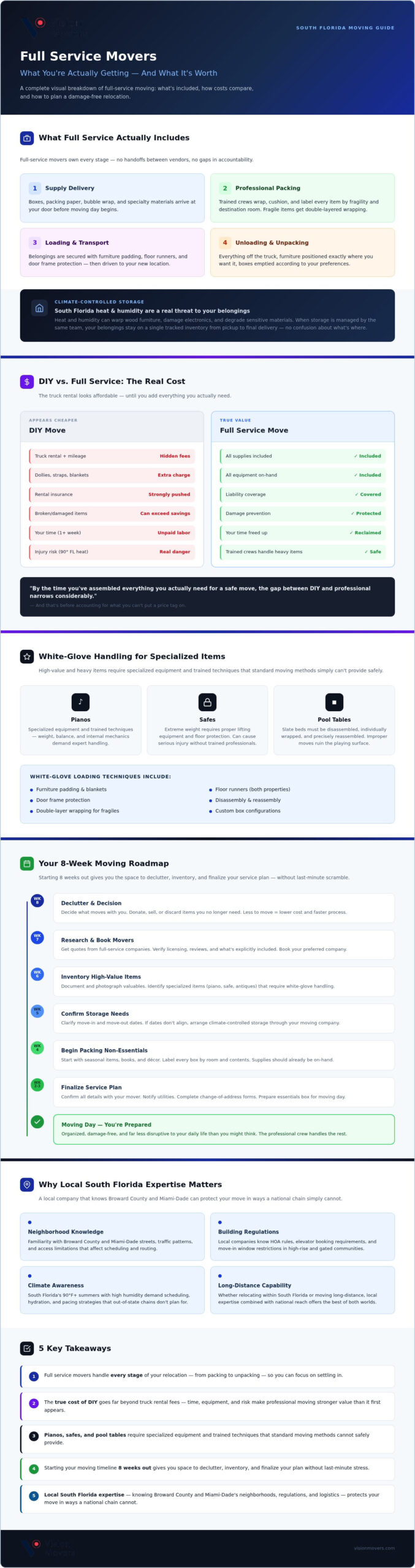
- Full service movers handle every stage of your relocation—from packing and loading to transportation and unpacking—so you can focus on settling into your new home instead of managing logistics.
- The true cost of a DIY move goes far beyond truck rental fees; once you factor in time, equipment, and risk, professional moving often delivers stronger value than it first appears.
- Heavy and high-value items like pianos, safes, and pool tables require specialized equipment and trained handling techniques that standard moving methods simply can’t provide safely.
- Starting your moving timeline eight weeks out gives you the space to declutter, inventory, and finalize your service plan without the last-minute scramble that leads to damaged belongings and added stress.
- Local expertise matters: a South Florida moving company that knows Broward County and Miami-Dade’s neighborhoods, building regulations, and logistics can protect your move in ways a national chain simply cannot.
What Does a Full Service Moving Company Actually Do?
Think of a full-service move as a turnkey logistics project: you hand over the keys to your current life, and trained professionals deliver everything intact to your next one. That’s not marketing language. It’s a genuine operational distinction that separates full service movers from every other option on the market, including labor-only crews and truck rentals where you’re still doing the heavy lifting, literally and figuratively.
A standard moving company might offer transportation and not much else. Full-service companies operate differently. They own every stage of the process, from the moment packing supplies arrive at your door to the afternoon your furniture is positioned exactly where you want it in your new home. Nothing falls through the cracks because there are no handoffs between separate vendors.
The core pillars of a full-service move typically include:
- Supply delivery: Boxes, packing paper, bubble wrap, and specialty materials arrive before moving day begins.
- Professional packing: Trained crews wrap, cushion, and label every item according to its fragility and destination room.
- Loading and transportation: Your belongings are secured in a properly equipped truck and driven to your new location.
- Unloading and unpacking: Everything comes off the truck, furniture gets positioned, and boxes are emptied according to your preferences.
The Full Service Spectrum
Professional packing is where the difference becomes most visible. Fragile items get double-layered wrapping and custom box configurations. Furniture is disassembled before the move and reassembled at the destination, protecting both the pieces and your walls during transit. White-glove loading techniques, including furniture padding, floor runners, and door frame protection, prevent property damage at both ends of the move. It’s a level of care that a rental truck and a few friends simply can’t replicate.
The Value of Integrated Storage Solutions
Closing dates don’t always align. When your move-out and move-in dates don’t match, integrated storage bridges the gap without disrupting your inventory or your peace of mind. Climate-controlled storage is particularly important in South Florida, where heat and humidity can warp wood furniture, damage electronics, and degrade sensitive materials quickly. When storage is managed by the same team handling your move, your belongings stay on a single tracked inventory from pickup to final delivery, with no confusion about what’s where or when it’s available.
DIY vs. Full Service Movers: Calculating the Real Cost
The truck rental looks affordable on the surface. Then you add fuel, moving blankets, dollies, furniture pads, and the insurance the rental company strongly encourages you to purchase. By the time you’ve assembled everything you actually need for a safe move, the gap between DIY and professional narrows considerably. And that’s before accounting for what you can’t put a price tag on.
Let’s break this down honestly.
A typical DIY move involves renting a truck, purchasing or borrowing packing supplies, recruiting help, and coordinating everything yourself over days or weeks. The hidden costs stack up quickly:
- Truck rental and mileage fees: Base rates don’t reflect the full picture once distance charges, fuel, and late return fees are added.
- Equipment hire: Furniture dollies, appliance straps, and moving blankets are rarely included in base rental costs.
- Replacement costs: A cracked television screen or a broken antique piece can easily exceed what you saved on the move itself.
- Your time: Packing a full household typically takes most people an entire week or more of evenings and weekends. That’s time you’re not working, resting, or managing the dozens of other tasks that come with a relocation.
In South Florida’s summer heat, there’s also a physical cost. Loading a truck in 90-degree humidity isn’t just uncomfortable; it’s a genuine injury risk. Back strains, heat exhaustion, and dropped furniture are all common outcomes when untrained people rush through a physically demanding job under pressure.
Time Savings Breakdown
A professional crew can pack a fully furnished home in a fraction of the time it takes a family working on their own. What might take a household two weeks of evenings often takes a trained team a single day. That efficiency translates directly into fewer days off work, less disruption to your routine, and a move that doesn’t consume your entire life for a month.
Liability and Valuation Coverage
This is where DIY moves carry their most underestimated risk. “Valuation coverage” in the moving industry isn’t the same as standard insurance; it refers to the carrier’s liability for your belongings during the move. Professional full service movers are held to federal and state safety and liability standards that don’t apply to a rental truck you’re driving yourself. If something breaks in your own truck, recovery options are limited. Working with a local moving service that understands these protections means your assets are covered by a structured accountability framework, not just goodwill.
The real cost of a DIY move isn’t what you spend. It’s what you risk. When you factor in time, physical strain, and the potential for irreplaceable losses, professional moving often delivers stronger value than the initial quote suggests. If you’re weighing your options, talking to a moving specialist before committing to either path is always a smart first step.
White-Glove Handling for Specialized and High-Value Items
Standard moving techniques work well for boxes and bedroom furniture. They fall apart entirely when the item weighs 500 pounds, costs thousands to replace, or requires disassembly that can’t be reversed if done incorrectly. This is where the gap between a general moving crew and genuine full service movers becomes impossible to ignore.
Specialized items demand specialized preparation. A concert upright piano can weigh anywhere from 400 to 800 pounds, and its internal mechanics are sensitive to both physical shock and environmental conditions. In South Florida’s climate, temperature and humidity shifts during transport can affect tuning stability and even cause structural damage to the soundboard if the instrument isn’t properly protected. Piano moving requires padded skid boards, precision tilting techniques, and a crew that understands exactly how weight is distributed across the instrument’s frame before a single wheel moves.
Pool tables present a different challenge. The slate playing surface is both extremely heavy and brittle, and the felt finish scratches with minimal provocation. Moving a pool table without disassembling it first risks cracking the slate and warping the frame. Protecting the felt requires non-abrasive wrapping materials and careful stacking protocols during transport. These aren’t optional precautions; they’re the difference between a table that plays true and one that needs expensive repairs before it’s ever used again.
Antique furniture adds another layer of complexity. Original finishes, hand-carved details, and aged joinery don’t respond well to standard moving blankets or pressure points during loading. Proper handling means custom padding, careful positioning in the truck, and zero contact with harder surfaces throughout transit.
Expert Safe and Heavy Item Relocation
Gun safes and heavy office equipment introduce structural considerations that most moving teams aren’t equipped to handle. A fully loaded gun safe can exceed 1,000 pounds, and moving it upstairs in a residential building or high-rise requires hydraulic lift equipment, reinforced dollies, and a team that has assessed the floor load capacity beforehand. Building management in multi-unit properties often has specific requirements for how heavy items can be transported through common areas, and a dedicated specialized team arrives prepared for those conversations and constraints.
- Hydraulic lift equipment: Essential for items that exceed safe manual carry weight on stairs or elevated floors.
- Floor protection: Runners and plywood panels prevent damage to hardwood, tile, and carpet under extreme load points.
- Structural pre-assessment: Identifying load-bearing capacity before moving day prevents costly property damage.
Commercial and Office Shifts
Business relocations carry stakes that residential moves don’t. Every hour of downtime has a direct operational cost, which means a commercial moving project needs precise scheduling, not just a moving date. IT infrastructure requires careful disconnection, labeling, and reconnection protocols to avoid data loss or equipment damage. Sensitive business records need secure handling from the first box packed to the last one placed. Coordinating loading dock access, elevator reservations, and building management approvals in advance keeps the project on schedule and prevents the kind of last-minute friction that turns a one-day move into a three-day disruption.
Preparing for Your Full Service Move: A 2026 Roadmap
A smooth move isn’t built on moving day. It’s built in the weeks before it. The households that arrive at their new homes without drama are the ones that started early, stayed organized, and knew exactly what to expect at each stage. Here’s how that timeline breaks down in practice.
Eight weeks out, the priority is decluttering and inventorying. Walk every room and make deliberate decisions about what’s coming with you. Donating, selling, or discarding items before your move reduces both your quote and the physical volume your crew needs to manage. This is also the right moment to photograph and document high-value belongings, furniture, electronics, and art, before anything is packed or moved.
Four weeks out, lock in your moving date and finalize your service plan. Moving windows in South Florida fill quickly, especially during peak season from May through August. Confirm every service detail in writing: packing, storage, specialty item handling, and delivery window. If your building has elevator reservation requirements or HOA move-in rules, initiate those conversations now, not the week before.
One week out, prepare your Essentials Box. This is a clearly labeled container that stays with you, not the truck, and holds everything you’ll need during the first 24 hours in your new home: phone chargers, medications, a change of clothes, toiletries, basic kitchen supplies, and important documents. When your team is still positioning furniture and breaking down boxes, you won’t be digging through a stack of unmarked cartons to find your toothbrush.
On move day, your white-glove crew will arrive with a clear plan already in place. Expect a walkthrough at the start where the team lead confirms room assignments, flags any special handling items, and reviews access points. Floor runners and door frame protectors go down before a single box moves. Your job that day is to stay available for questions and let the team work.
Inventory Management and Organization
A professional inventory created before packing begins serves two purposes: it keeps your unpacking service efficient, and it creates a documented record that supports any valuation coverage claim if something is damaged in transit. Room-specific labeling, where every box identifies both its contents and its destination room, allows the crew to place items precisely without a second trip. For high-priority spaces like your kitchen and home office, flag these clearly so they’re unpacked first and you’re functional within hours of arrival.
South Florida Specific Preparations
Moving in South Florida introduces variables that most general moving guides simply don’t address. Humidity is the first one. Electronics and solid wood furniture are both vulnerable to moisture during transport, particularly if a truck sits in direct sun for extended periods. Electronics should be packed in their original boxes when possible, or in anti-static wrap with sealed outer cartons. Wood furniture benefits from breathable padding rather than plastic sheeting, which traps condensation.
Afternoon storm scheduling matters more than most people realize. South Florida’s summer storm pattern is predictable: skies are typically clear in the morning and unstable by early afternoon. Scheduling your move to begin early allows loading to finish before conditions deteriorate, protecting both your belongings and your crew.
For residents of Miami-Dade and Broward County condos and HOA communities, building-specific logistics require advance coordination. Many properties in areas like Boca Raton and Fort Lauderdale require elevator reservations, certificate of insurance documentation from your moving company, and designated loading zones. A local full service movers team familiar with South Florida’s building management landscape arrives with those requirements already understood, which keeps your move on schedule regardless of what the property management office requests.
Ready to map out your move with a team that knows South Florida’s logistics inside and out? Talk to Vision Movers about building your moving plan today.
Choosing Vision Movers for Your South Florida Relocation
Vision Movers has been operating in South Florida since 2016, and that tenure represents something specific: years of learning the region’s quirks, building relationships with building managers, and refining the kind of white-glove service that turns a stressful day into a manageable one. This isn’t a national chain dispatching a crew that’s never seen a Brickell high-rise or a Weston HOA community. It’s a local team that already knows what to expect before the truck leaves the yard.
Pricing transparency is a core part of how Vision Movers operates. Your quote reflects the actual scope of your move, including packing, specialty item handling, and any storage requirements, with no line items that appear only after your belongings are loaded. That clarity matters, because the moving industry’s reputation for surprise fees is well-earned, and it’s not one Vision Movers shares.
The range of services is equally important. Whether you need senior moving support for a family member transitioning to a new living situation, a corporate relocation that can’t afford downtime, or specialized handling for a piano or safe, the same professional standards apply across every job. Full service movers should be able to scale their approach to fit the move, not the other way around. That’s the operational commitment Vision Movers brings to every project.
Our Service Areas: From Boca Raton to Coral Springs
Vision Movers serves communities throughout Broward County and Miami-Dade, including Parkland, Weston, Plantation, Fort Lauderdale, and Boca Raton. That localized knowledge has practical value. Parkland’s residential streets have different access considerations than Brickell’s loading dock protocols. Weston’s gated communities often require advance notice and certificate of insurance documentation before a moving truck can enter. Fort Lauderdale’s downtown corridors have parking restrictions that can derail an unprepared crew. Vision Movers arrives at each location already familiar with what’s required, which keeps your move on schedule and avoids the friction that catches out-of-market companies off guard.
Being a neighborly expert means understanding that South Florida isn’t one uniform market. It’s a collection of distinct communities, each with its own logistics landscape. That’s a meaningful advantage on moving day.
Get Started with a Custom Quote
Every move is different, which is why Vision Movers offers both on-site and virtual estimates to build an accurate picture of your specific needs before a price is ever confirmed. An on-site walkthrough allows the team to assess specialty items, stairwell access, and any building-specific requirements in person. A virtual estimate works well for straightforward residential moves where the scope is clear from a video walkthrough.
From there, your service package is built around what you actually need, whether that’s full packing and unpacking, storage between closing dates, or targeted specialty item handling. Ready to build your plan? Contact Vision Movers today and get a quote that reflects your move, not a generic template.
Your Next Move Starts with the Right Team
A relocation done right isn’t just about getting your belongings from one address to another. It’s about arriving at your new home without the damage, the delays, and the lingering stress that follow a move that wasn’t properly planned or executed.
The core lesson from everything covered here is straightforward: full service movers deliver value that goes well beyond convenience. Transparent pricing, white-glove handling standards, specialized equipment for heavy items like pianos and safes, and genuine local knowledge across Miami, Fort Lauderdale, and Broward County combine into a moving experience that protects both your belongings and your time.
Vision Movers has been built around exactly that standard since 2016. Every move gets the same disciplined, careful approach, whether it’s a studio apartment in Fort Lauderdale or a full commercial office relocation.
You’ve done the research. Now it’s time to put it to work. Get your free full-service moving quote from Vision Movers and start your relocation with a team that’s already prepared for everything your move requires.
Frequently Asked Questions About Full Service Movers
What is included in a full-service moving package?
A full-service moving package covers every stage of your relocation from start to finish. That includes packing supply delivery, professional packing of all your belongings, furniture disassembly, loading, transportation, unloading, furniture reassembly, and unpacking at your destination. Some packages also include storage if your move-in date doesn’t align with your move-out date.
The specific services included can vary between companies, so always confirm the scope in writing before signing anything. Ask explicitly whether unpacking and furniture placement are part of the base package or an add-on, since that distinction affects both your budget and your moving day expectations.
How much do full-service movers typically cost in Florida?
Florida moving costs vary based on the size of your home, the distance of your move, the volume of items being transported, and whether specialty services like piano or safe moving are required. Requesting an itemized quote is the most reliable way to understand your actual cost before committing.
Be cautious of any quote that arrives without a walkthrough or detailed inventory review. Accurate pricing requires a clear picture of your specific move. Vision Movers offers both on-site and virtual estimates to build a quote that reflects your real needs rather than a generic approximation.
Do full-service movers pack everything for you?
Yes. Full service movers handle all packing when you select a complete service package. Trained crews wrap, cushion, and label every item according to its fragility and destination room, from everyday kitchenware to delicate antiques. You don’t need to purchase supplies or touch a single box unless you want to.
If you’d prefer to pack some rooms yourself and have the crew handle the rest, many companies offer partial packing as a flexible option. Just clarify this during your estimate so the team arrives prepared for the correct scope of work.
How long does a full-service move usually take?
The timeline depends on the size of your home and the complexity of your move. A one-bedroom apartment typically takes a professional crew a single day to pack, load, transport, and unload. A larger home with multiple floors, specialty items, or a long-distance destination will naturally require more time.
What changes most significantly with a professional crew is efficiency. Tasks that might take a household two weeks of evenings to complete on their own are condensed into a structured, single-day or two-day operation. Your moving specialist can give you a realistic time estimate once the scope of your move is confirmed.
Are packing supplies included in the full-service price?
In most full-service packages, packing materials are either included or itemized separately in your quote. This covers boxes, packing paper, bubble wrap, furniture padding, and any specialty materials needed for fragile or high-value items. Always confirm this during your estimate so there are no surprises on moving day.
If you’re packing some items yourself, let your moving company know in advance. They can adjust the materials they bring accordingly and ensure the crew’s packing supplies are allocated to the rooms that need professional attention most.
Can full-service movers transport high-value items like safes and pianos?
Reputable full service movers with specialized capabilities can absolutely handle high-value items, but not every company is equipped to do so safely. Pianos, safes, and pool tables require dedicated equipment, trained handling techniques, and pre-move structural assessments that go well beyond standard moving procedures.
Vision Movers specializes in exactly these items. Moving a fully loaded safe can involve hydraulic lift equipment and floor protection planning. Piano transport requires padded skid boards and climate-aware protocols, particularly relevant in South Florida’s heat and humidity. Always confirm that your moving company has direct experience with your specific item before the truck is booked.
How far in advance should I book full-service movers?
Booking at least four to six weeks in advance is a practical baseline for most moves. In South Florida, demand peaks between May and August, and moving windows fill quickly during that stretch. If your move falls during peak season or involves specialty services, booking eight weeks out gives you the most flexibility.
Earlier booking also gives you time to coordinate building-specific requirements like elevator reservations and certificate of insurance submissions, which many Miami-Dade and Broward County properties require before a moving truck can access the premises. Leaving those details to the last week creates unnecessary friction that early planning avoids entirely.
What items are full-service movers prohibited from moving?
Moving companies are generally prohibited from transporting hazardous materials, including flammable liquids, propane tanks, paint, ammunition, and certain cleaning chemicals. Perishable food, plants, and pets also fall outside what a moving crew can safely transport in a standard truck.
Some items fall into a gray area depending on state regulations and individual company policies, so it’s worth asking your moving specialist for a specific list during your estimate. Plan to transport these items yourself or arrange separate disposal before moving day. Knowing this in advance prevents last-minute scrambles when the crew arrives and can’t load certain boxes.
Leave a Reply