
What if the key to a smoother office move isn’t moving faster, but protecting business continuity at every step? An office relocation checklist Miami businesses can use should bring employees, building contacts, and vendors onto one plan while accounting for access, loading, and timing across South Florida.
It’s natural to focus first on boxes, furniture, and moving day. But a well-organized relocation also needs clear task owners, realistic deadlines, and a plan for keeping essential work on track. This guide breaks the process into manageable phases so you can protect equipment, coordinate people, and prepare to resume work promptly.
You’ll find practical steps for planning the move, communicating with staff and vendors, arranging packing and transportation, and handling address updates with Sunbiz and the IRS. You’ll also see how to compare tasks your team can manage with professional commercial moving support, including packing and unpacking. Use the checklist to shape a move plan that fits your office, schedule, and continuity needs.
Key Takeaways
- Use an office relocation checklist Miami businesses can adapt to keep essential workflows and move tasks aligned.
- Build a phased timeline around your move’s complexity, with a clear owner and completion check for each milestone.
- Compare self-managed, professional, and combined moving approaches by staff workload, handling needs, coordination, and potential disruption.
- Separate employee responsibilities from moving-team handoffs so packing, moving day, and first-day checks stay organized.
- See how commercial moving support can fit your plan, including packing, transportation, and unpacking from a fully licensed and fully insured mover.
Why a Miami Office Relocation Checklist Starts with Business Continuity
Coordinating staff, property contacts, equipment, vendors, and daily operations is a substantial project. A successful office relocation isn’t simply everything arriving at the new address. It’s an organized transfer that protects essential workflows, clarifies who is responsible for each decision, and helps the business return to work with fewer avoidable interruptions.
That’s why an office relocation checklist Miami businesses can rely on should be built around continuity, not just moving-day logistics. Before setting dates, identify the work that must keep running, the teams that depend on it, and the steps required to make the new location operational. A Business Continuity Planning framework can help organize this thinking around potential disruptions and recovery priorities.
Set the move scope and decision-making team
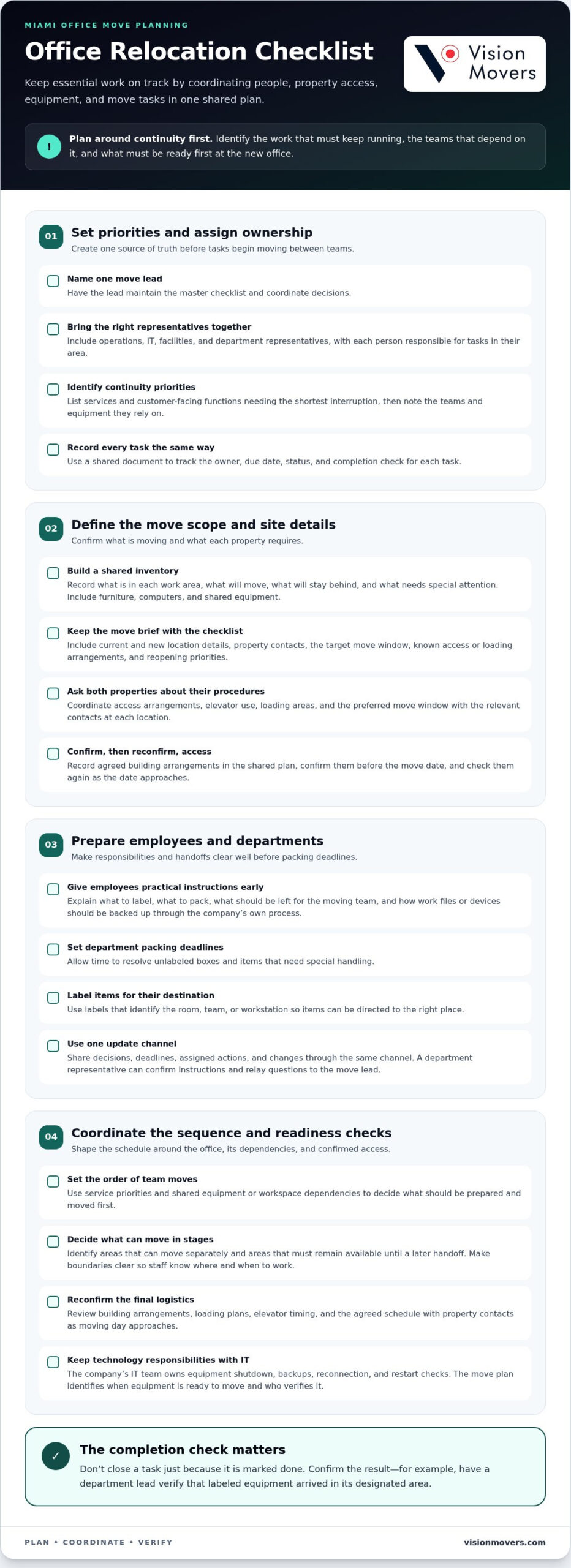
Name one move lead to maintain the master checklist and coordinate decisions. Add representatives for operations, IT, facilities, and department needs, giving each person responsibility for tasks within their area. This helps prevent gaps between groups, such as furniture being scheduled before a team has identified its equipment or workspace requirements.
Start a shared inventory that records what is in each work area, what will move, and what will stay behind or be handled separately. Include furniture, computers, shared equipment, and items that need special attention. Keep the basic move brief in the same shared document:
- Current and new location details, including the relevant property contacts.
- The target move window and known access or loading arrangements to coordinate with both properties.
- Reopening priorities, such as which work areas and equipment need to be ready first.
Use one shared source of updates rather than relying on scattered email threads or verbal handoffs. For each task, record the owner, due date, status, and completion check. Every move task should have an owner, deadline, and completion check. For example, a completion check might be a department lead confirming that labeled equipment arrived in its designated area, rather than simply marking “move equipment” as done.
Define continuity priorities before setting dates
List the services and customer-facing functions that need the shortest interruption. Then identify which teams rely on shared equipment, systems, or workspaces to deliver them. These dependencies help determine a sensible order for moving departments and preparing the new office. For example, a team handling time-sensitive customer work may need its essential setup ready before a less time-critical department begins unpacking.
Decide which areas can move in stages and which need to remain available until a later handoff. A phased sequence can help avoid shifting every team’s work at once, but it needs clear boundaries so staff know where and when to work. Set a communication rhythm, such as regular written updates and brief milestone reviews. Share decisions, deadlines, assigned actions, and changes through the same channel. With clear ownership and continuity priorities in place, the timeline can reflect the business’s actual needs.
Miami Office Relocation Timeline: Build the Checklist in Phases
A useful timeline gives each task enough lead time without assuming every office move follows the same calendar. The right planning window depends on factors such as the amount of furniture and equipment, the number of departments involved, and the coordination required at both properties. For an office relocation checklist Miami teams can actually use, organize work by phase and assign an owner and completion check to every milestone.
Building access can shape the schedule, so coordinate directly with the relevant contacts at both locations. Discuss access arrangements, elevator use, loading areas, and the preferred move window, then record the agreed details in the shared plan. Confirm access arrangements before the move date, then reconfirm them as it approaches.
Early planning: scope, building coordination, and staff notice
The move lead can start by confirming the scope, target dates, property contacts, and each building’s procedures. Ask the contacts what arrangements apply to your move rather than assuming access or loading works the same way at both addresses. Create an inventory of furniture and equipment, noting items that need careful handling and anything that will not be moved.
Give employees practical instructions early. Specify what to label, what they should pack, which work files or devices need to be backed up through the company’s own process, and what should be left for the moving team. Assign a department representative to confirm that instructions are complete and relay questions to the move lead.
Final weeks: confirm vendors, packing, and readiness
As moving day approaches, the move lead should revisit the building arrangements and confirm the loading plan, elevator timing, and agreed schedule with the property contacts. Set packing deadlines by department, allowing time to resolve unlabeled boxes or items that need special handling. Use destination labels that identify the room, team, or workstation so items can be directed to the right place.
Keep technology responsibilities distinct from moving tasks. The company’s IT team should own equipment shutdown, backups, reconnection, and restart checks. The move plan can identify when equipment is ready to move and who will verify it at the new office. If professional packing, loading, transportation, or unloading support is part of the plan, align those tasks with the same schedule.
Move day and reopening: verify the handoff
Prepare one contact list with the office lead, relevant building contacts, department representatives, and moving-team contact. The lead can use it to handle schedule changes and confirm each handoff. At the destination, check priority work areas and essential equipment against the reopening plan before teams resume normal work.
Keep a short unresolved-items list rather than relying on memory. Record the issue, its owner, and the next check-in, then share reopening arrangements and any outstanding tasks with staff. This gives employees a clear picture of what is ready and where to direct questions. If commercial moving support would help your team follow the plan, explore commercial moving support and call 561-618-0949 for a free estimate.
Miami Office Move Logistics: Compare the Options That Affect Your Plan
The right moving approach depends on the work involved, the staff available, and how much interruption the business can absorb. Compare the options against your actual needs, not just the number of boxes. This helps you decide which tasks employees can manage and where professional support may reduce workload or simplify handling.
| Approach | Control | Staff workload | Handling and coordination | Interruption exposure |
|---|---|---|---|---|
| Self-managed labor | Your team directs each task. | High, since employees pack, lift, and organize the move. | Staff manage furniture and equipment handling, transportation arrangements, and building coordination. | Work may be interrupted as employees divide time between moving and regular duties. |
| Professional moving support | The moving plan is coordinated with your designated lead. | Lower for physical moving tasks, leaving staff focused on business responsibilities. | Movers can handle agreed packing, loading, transportation, unloading, and unpacking. | May reduce the moving workload on employees, while operations still need a continuity plan. |
| Combined approach | Your team retains decisions about inventory, priorities, and destination setup. | Shared between employees and the moving team. | Staff manage business-specific preparation while movers handle agreed physical tasks. | Can limit staff involvement in heavy moving work, with disruption shaped by the schedule and handoffs. |
Choose the right balance of internal and moving-team responsibilities
Keep business decisions with the people who know the work. Internal teams should set inventory priorities, communicate with employees, and coordinate IT readiness. A moving team can take on physical tasks such as packing, loading, transportation, unloading, and unpacking according to the agreed scope.
A small office with available staff may prefer to pack routine items internally and arrange help for larger furniture or equipment. A more complex move, or one with limited employee capacity, may call for support across more stages. Consider office size, move complexity, staff availability, and any items that need careful handling. Write down the division of responsibilities so employees know what to prepare and what the moving team will handle.
Plan for Miami-area buildings, timing, and weather
When planning an office move in Miami, Fort Lauderdale, Boca Raton, Brickell, Weston, Plantation, Pompano Beach, Broward County, Hollywood, Dania Beach, Coral Springs, or Parkland, account for the specific access and loading arrangements at both addresses. Ask the contacts at each property about elevator use, loading arrangements, and scheduling procedures, then include the agreed details in the plan. Don’t assume the two locations follow the same process. Allow a schedule buffer for traffic, building coordination, and other project-specific delays, and share timing changes with the move lead and relevant teams.
Weather also belongs in the schedule plan. If a hurricane or heavy storm creates unsafe moving conditions, Vision Movers will work with you to choose a safer moving date. Build flexibility into department handoffs and reopening plans so a schedule adjustment can be communicated clearly without leaving staff unsure about next steps. Use your office relocation checklist Miami to record the chosen approach, task owners, and any agreed changes.
Office Relocation Checklist for Packing, IT, and Move-Day Handoffs
The final preparation works best when staff and the moving team know exactly which tasks belong to them. Add these checks to your office relocation checklist Miami plan, then use department labels and a destination map to guide each handoff. Keep a separate priority list for the work areas and equipment that must be ready first.
Prepare furniture, files, and work areas
Give each department its packing deadline and a simple labeling standard. Include the destination room, team, or workstation on every box, and mark items that need special handling in a consistent way. Label each packed item with its destination before it leaves the office. The move lead can share a destination map with employees and the moving team so labels have a clear reference.
- Staff: Pack assigned desk and department items, follow the labeling plan, and identify anything that should remain in place.
- Move lead: Record furniture that needs assembly or disassembly and communicate those needs in the move plan.
- Company representative: Handle sensitive business records under the company’s established procedures, rather than mixing them with general packed items.
Before packing begins, compare the inventory with the destination map. That review can reveal a workstation without a planned location or furniture that needs a different handoff.
Coordinate IT shutdown, transport, and restart
Assign the company’s IT lead responsibility for backups, disconnecting equipment, reconnection, and testing. The moving team can handle the agreed physical transportation of labeled items, while IT retains control of system readiness. Label computers, monitors, and cables by workstation or destination so the right components can be reunited during setup.
Use a clear handoff point: IT identifies equipment ready for transport, and the destination map shows where it belongs. After reconnection, test priority systems and connectivity before telling staff the office is ready for normal work. Keep remaining setup issues on a short list with a named follow-up owner.
Complete the move-day and first-day checks
At both locations, walk through the space with the designated contacts and note unresolved items. At the new office, check priority furniture and work areas against the inventory and destination plan. Don’t rely on boxes being in the right room as the only sign that a department is ready. Confirm that its essential equipment is present and that assigned setup checks have been completed.
- Staff should receive arrival instructions, workspace locations, and the person to contact if something is missing.
- The move lead should track open items, assign follow-up owners, and share updates about reopening arrangements.
- The IT lead should report which priority systems have been tested and flag any remaining setup needs.
If professional packing, transportation, or unpacking support would help your team manage these handoffs, request commercial moving support by calling 561-618-0949 for a free estimate.
Choose Miami Commercial Moving Support and Request a Clear Estimate
The right commercial moving support should match the tasks in your plan, so your team knows who handles each part. Compare the service scope, handling plan, communication, scheduling, and estimate clarity. A useful estimate should reflect the move’s needs and make clear which tasks are included, helping you coordinate internal responsibilities with the moving team’s work.
Match commercial moving services to the office checklist
Vision Movers provides Commercial Moving support with packing and unpacking, loading and unloading, transportation, and storage. Full Service Moving can also include assembly and disassembly, plus uninstallation and installation. The right combination depends on your move scope: employees might pack their work areas while the moving team handles larger furniture, transportation, and agreed unpacking.
Before confirming the plan, use your checklist to map each service to an owner and handoff. Specify what your team will prepare, which items need careful handling, and where furniture and equipment should go at the new office. Founded in 2016, Vision Movers has 4 trucks, 10 crew members, and 9+ years of experience. Vision Movers is fully licensed and fully insured for local and long-distance moves. All belongings are insured, and additional insurance is available if needed.
Set clear expectations before confirming the move
Move timing varies with complexity, volume, and distance, so plan around your office’s priorities rather than assuming every relocation follows the same schedule. Most local moves are completed the same day, while longer moves take a couple of days. These are general expectations, not a fixed duration for an individual project.
Same-day or last-minute service depends on team capacity. Vision Movers does not always have a team of last-minute movers available. Sharing your target dates and move details early helps make scheduling part of the planning conversation. Keep the estimate and agreed service scope alongside your checklist so the office lead, department representatives, and moving team are working from the same plan.
Vision Movers offers transparent pricing with no hidden fees. Exact costs are provided through a free personalized estimate based on the move. Review the scope and estimate together: confirm that the planned packing, handling, transportation, and unpacking support align with the responsibilities assigned to your staff.
Make the next step straightforward
Bring your inventory, target move window, building coordination notes, and priority areas together before discussing the project. That gives the move plan a practical starting point and helps clarify where professional support can reduce the work assigned to employees. Keep the office relocation checklist Miami teams are using close at hand so key details are easy to discuss.
Ready to plan your office move? Call Vision Movers at 561-618-0949 to discuss your needs and request a free personalized estimate.
Turn Your Move Plan Into the Next Step
Before the move gets underway, turn your working checklist into a shared reference your team can return to as plans develop. Keep the latest decisions and open questions together, and make sure the people responsible for each handoff know where to find them. That small habit helps the plan stay useful when details shift.
Your office relocation checklist Miami is also a practical starting point for shaping the right moving support. Use it to outline what your staff will handle, what you’d like help with, and which parts of the move need careful coordination. A clear scope makes it easier to discuss the project and receive an estimate tailored to your office’s needs.
Vision Movers is fully licensed and fully insured for local and long-distance moves. All belongings are insured, with additional insurance available if needed. Pricing is transparent with no hidden fees, and exact costs come through a free personalized estimate.
Take the next step with confidence. Request a free personalized office moving estimate by calling 561-618-0949, and start turning your move plan into a coordinated transition.
Frequently Asked Questions
How far ahead should I start planning an office relocation in Miami?
Start planning as soon as a move is likely, and set the lead time around your office’s scope rather than relying on a universal number of weeks. A small office with limited equipment has different dependencies from a multi-department move. A practical office relocation checklist Miami businesses can tailor begins with the target window, then works backward through property coordination, technology changes, employee notice, and vendor transitions.
What should an office relocation checklist include?
Include the move scope, target dates, staff responsibilities, building contacts, inventory, packing instructions, technology tasks, and reopening priorities. Add administrative updates that can be easy to overlook: update the business address with Florida’s Division of Corporations through Sunbiz and file IRS Form 8822-B for a business address change. Keep these items in the same task tracker, with an owner and status, so paperwork doesn’t get lost among physical move preparations.
How can an office move minimize business downtime?
Decide what “ready to work” means for each team before moving day. For a customer-facing department, that might mean its workstations, connectivity, and essential tools are available before routine storage areas are unpacked. Identify a temporary way to handle urgent work if a system takes longer to restart, and tell staff where to direct time-sensitive requests. This gives the business a clear fallback while the remaining setup is completed.
Can office movers work after hours or on weekends in Miami?
Yes. Vision Movers offers flexible scheduling, including after-hours, weekends, and holidays, subject to project arrangements. A nonstandard move window may help a business coordinate around its work schedule, but it still needs to fit the property’s access arrangements and the move plan. Align the proposed timing with the office lead and building contacts so employees know when to prepare, when the handoff occurs, and when to return.
What happens if a hurricane or heavy storm affects moving day?
If a hurricane or heavy storm creates unsafe conditions, Vision Movers will work with you to choose a safer moving date. Keep staff informed about the revised plan and avoid asking employees or the moving team to proceed in dangerous weather. You can also identify which preparation tasks remain useful if the date changes, such as updating labels or completing internal address notifications, to keep the transition organized.
Are belongings insured during an office move with Vision Movers?
Yes. All belongings are insured during a move with Vision Movers, and additional insurance is available if needed. Vision Movers is fully licensed and fully insured for local and long-distance moves. For a business relocation, keep an inventory of office items and note any that need special handling in the move plan. This gives your team a clear reference as belongings are prepared and transferred to the new workspace.
How much does a Miami office relocation cost?
The cost depends on the details of the move, so Vision Movers provides exact costs through a free personalized estimate rather than a universal price. The estimate reflects the office move’s scope, including the items being moved and the support requested. Vision Movers offers transparent pricing with no hidden fees. Share your inventory and planned services to receive an estimate tailored to the relocation.
Does Vision Movers offer same-day or last-minute office moving?
Same-day and last-minute moving may be available depending on team capacity, but Vision Movers does not always have a team of last-minute movers available. If your move is time-sensitive, share the target date and key details early. That gives the team a clearer picture of the schedule and lets you plan a backup date or sequence in case the requested timing can’t be accommodated.
Leave a Reply