
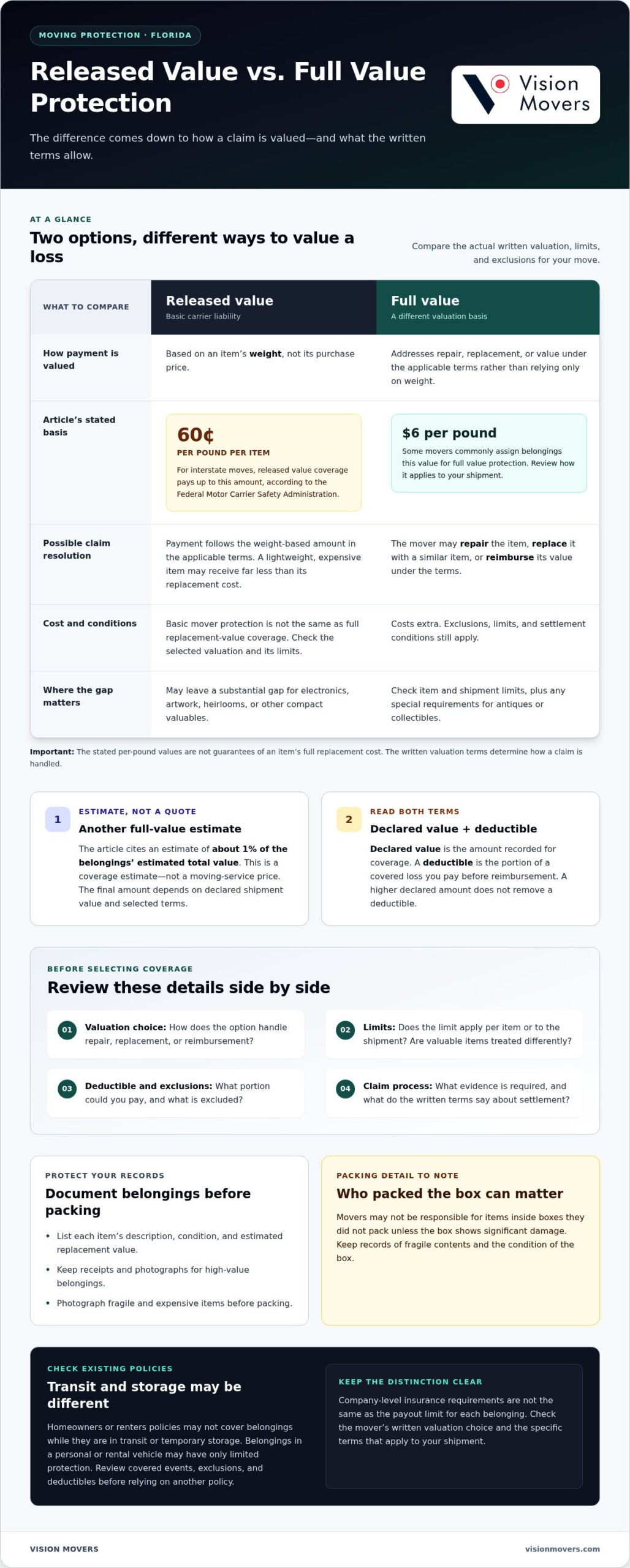
Basic mover protection isn’t the same as full insurance. For interstate moves, released value coverage pays up to 60 cents per pound for an item, according to the Federal Motor Carrier Safety Administration. So, when comparing moving insurance options in Florida, don’t assume your belongings are automatically covered for their full replacement value.
It’s reasonable to expect protection while your household goods are in transit, but the type of coverage and its limits determine what you may recover after a loss. The details matter most for valuable, fragile, or hard-to-replace belongings.
This guide explains the main types of mover protection, what can affect coverage costs, and how to review policy limits. You’ll also learn how to document belongings with an inventory and photos, so you’re better prepared if you need to make a claim.
Key Takeaways
- Basic mover protection doesn’t automatically cover the full replacement value of belongings. For interstate moves, released value coverage pays up to 60 cents per pound per item, according to the Federal Motor Carrier Safety Administration.
- Compare how each option handles repair, replacement, reimbursement, deductibles, and exclusions before deciding what protection fits your move.
- Review policy limits for valuable or hard-to-replace belongings, and understand how any existing home policy treats items in transit or storage.
- Create an inventory and take clear before-and-after photos to help show an item’s condition and support a claim.
- Keep your moving documents and claim details together so you can act promptly if something is lost or damaged.
Do movers in Florida automatically provide full insurance for my belongings?
Not necessarily. Basic mover liability and full value protection are different, and homeowners or auto coverage may leave gaps during transit. The right moving insurance options in Florida depend on your move, your belongings, and the policy limits.
Existing Policies During Transit
A homeowners policy may not cover belongings while they’re being moved, so review its terms for transit and storage. Renters coverage also depends on the policy wording. Property may fall outside a home policy’s usual coverage while it’s in a truck or temporary storage.
Coverage for Fragile and Expensive Items
For fragile or expensive belongings, match the protection to the item’s value and the potential loss. A lightweight heirloom can have a high replacement cost, so per-pound coverage may fall far short. List valuable items separately and review how the selected option handles repair, replacement, or reimbursement.
Consider how packing affects a claim, too. Movers may not be responsible for items inside boxes they didn’t pack unless the box shows significant damage. Keep receipts, identify fragile contents, and photograph each item before packing. These records help document what was moved and its condition.
Released Value and Per-Pound Coverage
Released value protection bases payment on an item’s weight, not its purchase price. For interstate moves in the United States, released value coverage is basic carrier liability coverage and pays up to 60 cents per pound for an item, according to the Federal Motor Carrier Safety Administration.
Full value protection differs because it addresses an item’s repair, replacement, or value rather than relying only on weight. That distinction matters for compact valuables: a lightweight electronic device can be worth far more than its weight-based payment. Compare the valuation option, limits, and exclusions in the move documents.
Accidents, Losses, and Valuation Disclosures
Valuation coverage explains how a mover handles loss or damage, while insurance terms may set additional limits and exclusions. Accidents, missing cartons, and damage noticed at delivery can each raise different questions. Read the written terms for your selected option, the claims process, and the evidence required.
What are Florida movers required to disclose about valuation coverage? Florida movers must carry insurance for loss or damage to household goods, but that doesn’t mean every item receives full replacement-value protection. Review the written valuation choice and its limits before moving.
How can you verify a Florida moving company’s license and insurance? Florida movers must register with the Florida Department of Agriculture and Consumer Services. Consumers can call 1-800-HELP-FLA to check registration and complaint history. For intrastate moves, the stated minimums are $10,000 in cargo liability coverage and $300,000 in general liability insurance. Don’t treat those company-level amounts as the payout limit for each belonging.
Released value protection
Released value protection is basic carrier liability, while full value protection uses a different basis for resolving eligible losses. This distinction affects what a damaged or missing item may be worth in a claim. Compare the written terms with the actual value of your belongings before choosing.
Under released value protection, compensation is calculated by item weight, not purchase price. A moving company may therefore pay much less for a lightweight, expensive object than its replacement would cost. This option may suit belongings with modest replacement costs, but can leave a substantial gap for electronics, artwork, or heirlooms.
Assess belongings individually, not just by the shipment’s total weight. Record each item’s description, condition, and estimated replacement value, then keep receipts or photographs for high-value pieces. A careful inventory shows where basic, weight-based coverage may not match an item’s actual worth and gives you a clearer basis for comparing valuation choices.
With full value protection, the mover may repair an item, replace it with a similar item, or reimburse its value under the applicable terms. The protection costs extra, and exclusions, limits, and settlement conditions still matter. Some movers commonly assign belongings a value of $6 per pound for full value protection, so review how that valuation applies to your shipment.
Another estimate places the charge at about 1% of the belongings’ estimated total value. These are coverage estimates, not moving-service prices. The final amount depends on the declared shipment value and the coverage terms selected.
Declared value is the amount recorded for coverage purposes; a deductible is the portion of a covered loss you pay before reimbursement. Read both terms together: a high declared amount doesn’t remove a deductible, which can reduce a claim payment. Confirm whether the limit applies per item or to the shipment, and note any special requirements for antiques or collectibles.
To compare moving insurance options in Florida, put the valuation choice, deductible, exclusions, and claim process side by side. For a move that also needs organized handling and transport, residential moving support can help keep the relocation plan clear.
Checking policy terms and limits with an insurance agent
An insurance agent can help compare your household policy with the mover’s valuation terms. Before deciding what protection applies, focus on transit, storage, exclusions, limits, and deductibles.
Reviewing Policy Terms and Limits
Ask the agent to review your homeowners or renters policy for belongings in transit and temporary storage. Some homeowners policies may offer limited moving coverage, but often aren’t comprehensive. Exclusions and deductibles can determine whether a damaged item qualifies and what you could recover.
Bring the mover’s written valuation terms and a list of costly belongings. Ask how the policy treats a missing television, a damaged antique, and property in temporary storage. Compare the answers with the mover’s terms, then note the applicable limit, claim steps, and required proof. This comparison can reveal where coverage overlaps or leaves a gap.
Moving Insurance Policy Types
Moving protection may come through released value protection, full value protection, or separate third-party coverage. Released value protection uses weight-based carrier liability, while full value protection addresses repair, replacement, or reimbursement under its terms. Separate liability insurance offered by some movers is governed by state law and pays the purchased insurance amount minus the mover’s basic carrier liability payment.
Third-party moving insurance can cover a remaining loss after basic mover coverage, up to the amount purchased. Its estimated rates range from 1% to 5% of the total valuation. Ask the agent to distinguish a separate policy from an endorsement on your homeowners coverage. For an interstate shipment, also compare the carrier’s valuation documents with any outside policy.
Coverage names alone don’t tell you what happens after damage. Check whether the protection covers goods in transit, temporary storage, accidental damage, and special items. A policy might cover a household shipment but exclude a particular valuable item. Review exclusions and item limits together instead of relying on a label such as “comprehensive.”
Policy Bundling and Deductible Strategies
Bundling means placing related insurance policies with one carrier; a deductible is the amount paid before coverage responds. An agent can compare the combined premium, exclusions, and claim terms with separate policies. A lower premium may come with a higher deductible or narrower protection, so weigh the overall trade-off.
A $5,000 deductible can reduce premiums but may expose a moving company to multiple claims in one month. That example concerns a moving company’s policy, not a household deductible recommendation. For your own coverage, compare the deductible with the value of belongings you could afford to repair or replace, and check whether separate claims trigger separate deductibles.
Before choosing, ask the agent to summarize the coverage limit, deductible, exclusions, and claim process in writing. Keep the summary with your inventory and moving documents. If an accident happens, these records can help identify which policy applies and what evidence the insurer requires.
Creating an inventory and documenting belongings for a claim
A useful claim record links each household belonging to its condition before transit and after delivery. An inventory, clear photographs, and proof of value can help establish whether an item was moved and whether it was damaged during the move.
Start with a room-by-room inventory before packing begins. Describe each item specifically, including its make, model, color, and visible wear. “Black television” is less useful than “50-inch black television, screen intact, small scratch on left frame.” Add receipts or purchase records when available, especially for expensive belongings. A clear description helps distinguish similar items and compare the claimed loss with the item’s actual condition.
Photograph valuable or fragile items from several angles before packing. Take clear pictures of existing scratches, dents, or chips, then photograph the item again after delivery if damage appears. Include a wider image showing the item’s location in the room and a close-up of its condition. Keep the photos with your inventory so each image matches a specific entry.
- Record the item’s description, condition, and estimated replacement value.
- Photograph existing marks and fragile details before packing.
- Keep receipts, appraisals, and inventory records together.
- After delivery, photograph damage and retain the affected item and packing materials.
For belongings in transit, save the signed inventory, moving documents, and written valuation selection. These records help establish which items the movers transported and what coverage applies. Moving insurance may cover goods in transit and temporary storage, but policy terms determine covered events and exclusions. Homeowners coverage may be limited during a move, so keep relevant policy details with the mover’s paperwork.
A declared value should reflect what an item would cost to replace, not just its weight or sentimental importance. Note the source for each estimate, such as a receipt, current product listing, or appraisal. For an antique without a recent receipt, an appraisal can provide a clearer basis for the claim record. Keep declared values consistent across the inventory and coverage documents.
After delivery, compare the shipment with your inventory and note missing cartons or visible damage. File moving claims promptly to facilitate reimbursement. Identify the affected items, describe the damage, and attach matching photos and records. If a box is damaged, photograph its exterior before opening it, then document the contents and packing materials.
Coverage exclusions matter, too. Moving insurance may exclude natural disasters such as hurricanes, tornadoes, windstorms, fires, and hail. An inventory documents what you owned and its condition, but doesn’t change an exclusion or expand a policy limit. Keep a copy of your records separate from the shipment so it remains accessible if belongings are lost.
Moving insurance providers
Third-party coverage can supplement a mover’s basic liability, while the policy terms define which losses qualify. To buy it, choose coverage based on your shipment’s declared value and review covered events, exclusions, and claim requirements.
Moving Insurance Provider Options
Moving insurance providers offer separate coverage for belongings during a move, with terms that vary by policy. A mover’s liability and an insurance policy may treat the same lost or damaged item differently. Compare who handles the claim, which valuation applies, and whether the policy covers transit or temporary storage.
Some moving insurance is offered for in-state, out-of-state, and international moves by land, air, and water. For a Florida relocation, the move’s distance and route help determine which policy terms apply. An estimate for third-party coverage ranges from 1% to 5% of the total valuation. Treat that percentage as a coverage estimate, not a moving-service price.
Check the written policy for the maximum payable amount, item-specific limits, exclusions, and documentation requirements. Coverage for a shipment, for example, doesn’t necessarily mean every antique or piece of jewelry is covered in full. Compare the policy’s valuation basis with the mover’s liability to see whether the protections overlap or address different losses.
Buying Third-Party Coverage
Third-party moving insurance may cover a remaining loss after the mover’s basic coverage, up to the amount purchased. Some policies may also cover accidents, natural disasters, and special items such as antiques and jewelry. This option may matter when released value protection leaves a large gap between the mover’s payment and an item’s replacement value.
Before buying, set out the shipment’s declared value and identify belongings needing special attention. Compare the policy’s coverage period, exclusions, deductible, and claim procedure with the mover’s valuation documents. A policy may cover goods in transit but set different terms for storage. Confirm that the policy wording addresses the specific storage arrangement.
Keep the insurance certificate, inventory, receipts, and photographs together. If a lamp arrives broken, for example, the inventory can show it traveled with the shipment, while before-and-after photos document its condition. A claim may also require proof of value and prompt notice. Follow the policy’s reporting process and retain copies of every document you submit.
For a clear plan that separates protection choices from move logistics, plan your Florida move and keep your coverage documents with your shipment records.
Vision Movers: Local Moving
Vision Movers coordinates local, residential, interstate, and commercial moves, helping turn your coverage decisions into a practical relocation plan. Once you’ve compared valuation terms and documented your belongings, coordinating packing, loading, and transport can keep the moving details organized.
For a local household move, clear planning connects your inventory and moving documents with the shipment. For an interstate relocation, keep the move paperwork and selected coverage details accessible throughout transit. Vision Movers provides moving services, while your policy or valuation documents explain how eligible losses are handled.
If you’re planning a move and need support with the logistics, contact Vision Movers or visit visionmovers.com.
Make Your Coverage Choice Part of the Move Plan
Use your coverage decision to plan the practical details of your relocation. Keep policy documents and your inventory accessible, and tell the person coordinating the move which belongings need careful handling. This organization connects your protection choices with the actual shipment, rather than leaving insurance paperwork separate from moving-day plans.
The right next step depends on the move ahead. Vision Movers offers local, residential, and interstate moving, supporting the logistics while you keep your coverage terms and claim records organized. As you compare moving insurance options in Florida, consider how your route and household needs fit with the protection you choose.
For help planning your relocation, contact Vision Movers about your move. A clear plan can make the transition ahead feel more manageable.
Frequently Asked Questions
Does my homeowners policy cover a move?
Sometimes, but homeowners coverage may be limited while belongings are in transit or temporary storage. Check the policy’s “off-premises” or transit provisions, exclusions, deductible, and any limit for high-value property. A policy may treat an item damaged in a moving truck differently from one damaged inside your home. Keep the policy documents handy when comparing them with the mover’s valuation paperwork.
How Do I Choose the Right Coverage for My Needs?
Choose by comparing each item’s replacement value with the amount payable under the coverage option. A lightweight laptop or framed artwork may need closer review than ordinary household goods because weight-based liability can fall well below replacement cost. Also consider exclusions, deductibles, and storage. For a move in Miami, Fort Lauderdale, Boca Raton, Brickell, Weston, Plantation, Pompano Beach, Broward County, Hollywood, Dania Beach, Coral Springs, or Parkland, use the same item-by-item comparison.
What do I need to file a claim?
Gather the signed moving documents, inventory, photographs, and proof of value for each affected item. A receipt, appraisal, or product record can help support the amount claimed. Photograph damage and retain the item and its packaging when practical. If a carton arrives crushed, for example, record its condition before opening it, then photograph the contents. Keep copies of submitted documents and note when you reported the issue.
What moving insurance coverage options are available in Florida?
Common choices include released value protection, full value protection, and separate third-party moving insurance. Released value protection bases payment on weight, while full value protection addresses repair, replacement, or reimbursement under its terms. Third-party coverage may supplement the mover’s basic liability. Compare the valuation basis, shipment limits, exclusions, deductibles, and claim process. Belongings in storage may have different terms from goods traveling directly to the destination.
Is moving insurance required for Florida moving companies?
Florida movers must carry insurance for loss or damage to household goods. For intrastate moves, the stated minimum cargo liability coverage is $10,000. That company-level requirement doesn’t mean every item is protected for its full replacement value. Vision Movers states that all belongings are insured and additional insurance is available if needed. The company also states it is fully licensed and fully insured for local and long-distance moves.
How much does moving insurance cost in Florida?
Cost depends on the shipment’s declared value, selected coverage, deductible, and items needing special protection. Third-party moving insurance estimates range from 1% to 5% of total valuation. Full value protection is also estimated at about 1% of belongings’ estimated total value. Treat these as coverage estimates, not a quote for moving services. The policy’s valuation rules and exclusions matter alongside the premium.
Does homeowners or renters insurance cover belongings during a move in Florida?
Either policy may offer limited protection, but coverage during transit or storage depends on its terms. Renters should review personal-property limits, covered events, and exclusions, just as homeowners should. Check how the policy treats belongings in a personal or rental vehicle, too, since auto or home coverage may be limited. A written comparison of transit, storage, and vehicle provisions can help identify gaps before moving day.
How do I file a moving damage or loss claim in Florida, and what are the deadlines?
Report damage or missing belongings promptly and follow the claims process in your mover’s documents or insurance policy. Deadlines and required forms depend on the applicable coverage terms, so follow the written instructions for your shipment. Include the item’s inventory entry, condition photos, proof of value, and a clear description of the loss. Save copies of the claim and related communications, and record when each document was submitted.
Leave a Reply