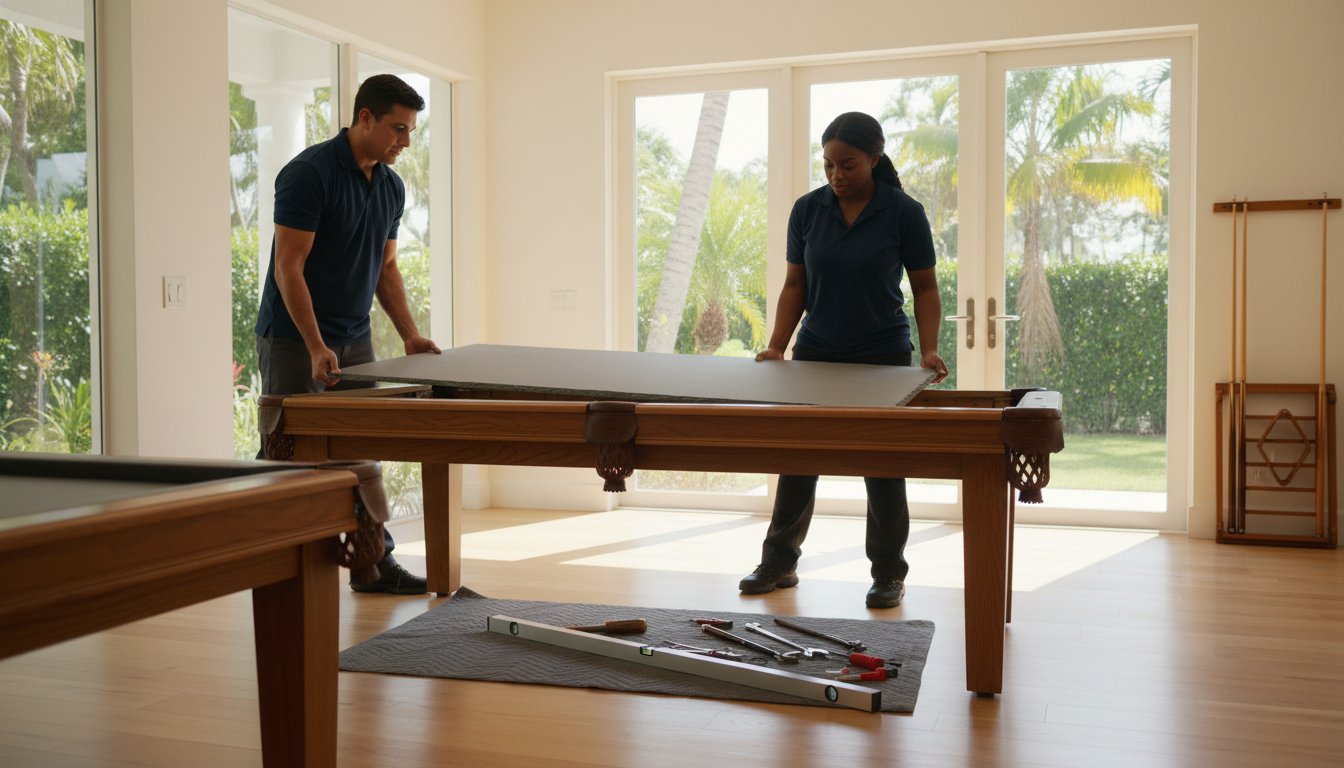
A pool table isn’t just a heavy piece of furniture; it’s a precision engineering project that happens to weigh up to 2,500 pounds. While it’s tempting to think enough muscle can get the job done, pool table moving is actually a delicate surgical process where a single mistake can lead to a cracked slate or a permanently warped frame. You’ve likely invested significantly in your equipment, and the fear of damaging such a centerpiece during a transition is a completely valid concern for any owner.
We understand that the specialized tools and the complexity of re-leveling a three-piece slate can feel overwhelming. This guide is designed to replace that stress with a clear, methodical plan for success. You’ll learn the precise steps to safely disassemble and transport your table without risking its structural integrity. We also provide a practical framework to help you decide when to tackle the project yourself and when it’s best to call in professional support. By the end of this article, you’ll have the expert knowledge required to ensure your table is perfectly level and ready for play in its new home.
Key Takeaways
- Understand the critical anatomy of your table and why its unique weight distribution requires a specialized approach rather than standard lifting techniques.
- Learn why complete disassembly is essential for protecting the delicate slate from vibration damage and structural stress during truck transport.
- Evaluate the hidden risks and significant time commitments of DIY pool table moving compared to the efficiency and safety of hiring a professional team.
- Follow a structured, step-by-step sequence for removing pockets, rails, and felt to ensure every component remains in pristine condition for reassembly.
- Gain a clear framework for achieving a perfectly level playing surface while protecting your home’s flooring and walls throughout the relocation process.
Understanding the Mechanics of Pool Table Moving
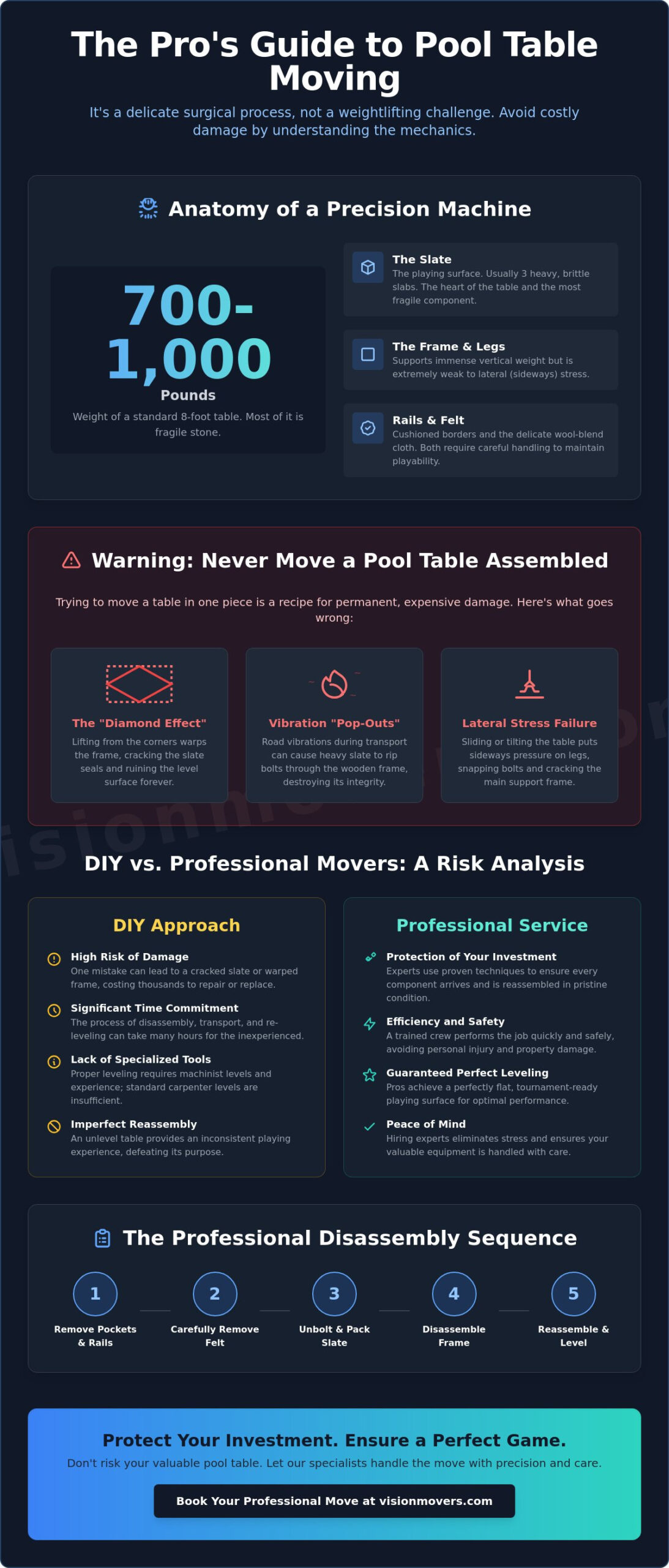
A pool table is a sophisticated piece of equipment that requires a level of care far beyond standard household furniture. While most items in your home can be lifted and carried with basic care, pool table moving is a technical process involving hundreds of pounds of fragile stone and precision-engineered wood. A standard 8-foot table typically weighs between 700 and 1,000 pounds. The majority of that weight is concentrated in the slate bed. Understanding Billiard table construction is the first step in realizing why you can’t simply treat it like a heavy sofa. The anatomy consists of four main components:
- The Frame: The heavy wooden base that supports the entire structure.
- The Slate: The playing surface, usually comprised of three heavy slabs.
- The Felt: A delicate wool-blend cloth that must remain perfectly smooth.
- The Rails: The cushioned borders that provide the bounce for the balls.
Each part is designed to work in perfect harmony to provide a consistent playing surface. Even a slight misalignment during a move can ruin the table’s playability or lead to permanent damage.
Why Weight Distribution Matters
The legs of a professional table are designed to support immense vertical weight. They excel at holding up the slate and frame, but they aren’t built for lateral stress. If you try to slide a table even an inch, you risk snapping the leg bolts or cracking the frame. Inside the frame, manufacturers use honeycomb or cross-beam support structures to keep the slate from sagging. These beams are calibrated to hold the weight evenly across the entire surface. Because these components are so sensitive, professional pool table moving always involves complete disassembly to protect these internal structures from shifting or warping.
The Role of the Slate
Slate is the gold standard for billiard surfaces because it’s naturally flat and heavy enough to remain stable. Most high-end tables use a three-piece slate system. These three separate slabs are joined together with wax during installation to create a seamless surface. While slate is incredibly hard, it’s also brittle. One wrong tilt or a sudden drop can cause a hairline fracture that’s impossible to repair. Improper storage is another risk. If slate slabs are leaned against a wall at a steep angle, they can develop a permanent dip over time due to their own weight. This is why professional handling is vital for preserving the integrity of the stone.
Why Disassembly is Non-Negotiable for Safety
Moving a pool table in one piece might seem like a shortcut, but it’s a recipe for structural failure. Professional pool table moving protocols require full disassembly for several critical reasons. When a table is fully assembled, it’s an unbalanced 900-pound hazard that puts everyone involved at risk. Even with a large crew, an assembled table is difficult to grip and nearly impossible to maneuver through standard residential doorframes. This often leads to awkward angles that violate proper lifting techniques, which increases the likelihood of back injuries or dropped equipment.
Beyond personal safety, the table’s integrity is at stake. During truck transport, road vibrations act on the heavy slate slabs. Because the slate is bolted to the frame, these vibrations can cause “pop-outs.” This happens when the heavy slate shifts slightly and the bolts rip through the aged wood of the frame. Once this wood is compromised, the table may never hold a level position again. If you’re concerned about the longevity of your investment, choosing professional pool table moving services ensures these risks are mitigated before the table ever enters a truck.
The Danger of Moving Assembled Tables
Lifting an assembled table from the corners creates what experts call the “diamond effect.” The immense weight of the slate forces the rectangular frame to warp into a diamond shape. While this flex might be invisible to the eye, it’s enough to crack the beeswax seals between the three slate pieces. Once those seals break, you lose the perfectly flat playing surface you expect. Additionally, most modern homes have 30 to 36-inch doorframes. An assembled table simply won’t fit without being turned on its side, which puts catastrophic lateral pressure on the legs and frame joints.
Protecting the Felt (Baize)
The felt is the most delicate part of the assembly. Baize is the specialized wool and nylon blend used for consistent ball speed and durability. During disassembly, every staple must be removed individually with precision. Rushing this process or trying to “peel” the cloth back can cause micro-tears around the bolt holes. Replacing high-quality baize is a significant expense that can be avoided with patience. Carefully rolling the cloth instead of folding it prevents permanent creases that would otherwise disrupt the roll of the ball during play.
DIY vs. Professional Pool Table Movers: A Risk Analysis
Choosing to handle pool table moving without professional assistance often seems like a logical way to save money. However, the logistical reality is far more complex than simply gathering a few friends and a truck. A beginner typically spends 4 to 6 hours navigating the intricate disassembly and reassembly process. In contrast, a professional team can often complete the entire task in under 2 hours. This time difference isn’t just about speed; it’s about the precision that comes with repetition and specialized training.
Beyond the time commitment, you must consider the specialized equipment required for a successful move. While you can find general guides on how to move a pool table safely, the cost of purchasing high-quality staple pullers, socket extensions, and specialized beeswax can quickly erode your projected savings. There are also significant hidden costs associated with DIY mistakes. If a slate slab chips or the felt is improperly stretched during the move, the resulting repair bills often exceed the original cost of hiring experts. Professionals provide an essential layer of security by carrying cargo and liability insurance. This coverage protects your high-value asset against unforeseen accidents in a way that a weekend DIY project simply cannot.
Required Specialized Tools for DIY
You cannot rely on a standard carpenter’s level for this task. Billiard tables require a machinist level, which is accurate to within .005 inches per foot, to ensure a truly flat playing surface. Using a less accurate tool often results in subtle “rolls” that ruin the game. You’ll also need specialized shims for leveling, heavy-duty moving blankets to prevent frame scuffs, and custom slate crates. These crates are essential for supporting the stone slabs vertically, as laying them flat during transport is a primary cause of slate fractures.
The ‘Friend Factor’ and Liability
Relying on friends to help lift 300-pound slate slabs introduces a significant risk of personal injury and property damage. While general labor might be helpful for moving boxes, furniture movers near me are specifically trained to handle the awkward weight distribution of billiard components. Professional movers provide peace of mind through a ‘Leveling Guarantee.’ This ensures your table isn’t just relocated, but is also perfectly calibrated for a professional-grade roll the moment the job is finished. This level of accountability is something you won’t get from a group of well-meaning volunteers.
Step-by-Step Guide: How to Move a Pool Table Safely
The process of pool table moving begins with meticulous organization. First, you must remove the pockets and rails. We recommend labeling each piece of hardware and rail section immediately. Every table settles differently over time, and keeping the original alignment ensures that the bolt holes match perfectly during reassembly. Once the rails are clear, the felt must be detached. Instead of folding the cloth, which creates permanent creases that ruin ball roll, you should roll it tightly around a cardboard tube or a dedicated foam cylinder.
Removing the slate is the most physically demanding phase. You’ll need at least two or three people to lift each slab safely, as they often weigh over 200 pounds each. Once the slate is removed, the frame and legs are disassembled for flat-pack transport. This approach protects the wooden joints from the lateral stresses discussed in previous sections. If you’re coordinating a larger household transition, consulting a local moving service can help you prepare the room and clear a path for these heavy, awkward components.
The Art of Leveling and Seaming
Achieving a professional-grade playing surface requires a machinist level. Standard levels simply don’t provide the .005-inch accuracy needed for a fair game. Leveling happens in two stages: first at the floor by adjusting the legs and then at the slate bed using specialized hardwood shims. After the slabs are perfectly aligned, we melt beeswax into the seams. Once the wax cools and is scraped flush with a razor, it creates a mirror-smooth surface. This prevents the ball from “jumping” or veering as it crosses the joints between the slate pieces.
Re-felting and Tensioning
Properly stretching the felt is a delicate balance of tension and patience. If it’s too loose, you’ll encounter “dead spots” where the ball slows down unexpectedly or tracks poorly. In South Florida, humidity management is a critical factor that many DIY guides overlook. High moisture levels can cause the wool-nylon blend to expand, leading to unsightly wrinkles weeks after the move. We ensure the room is climate-controlled for several hours before tensioning the cloth to prevent this expansion. This careful attention to detail is why our clients trust us with their pool table moving needs.
Don’t leave your table’s performance to chance. Schedule your professional pool table move with our expert team today.
Professional Pool Table Moving in South Florida
Relocating a high-value billiard table in South Florida demands a deep understanding of local environmental factors. At Vision Movers, we specialize in pool table moving across Broward County and the surrounding areas, focusing on the preservation of both the table and your property. The intense Florida heat can be brutal on antique wood frames, while the humidity levels in places like Fort Lauderdale can compromise the elasticity of the cloth. We address these challenges by using breathable, non-abrasive wraps and ensuring that our transport vehicles are optimized for delicate cargo. Our white-glove approach means we don’t just move the item; we safeguard every inch of your home’s interior with specialized protective gear.
We understand that a pool table is often the centerpiece of a room. Our teams utilize heavy-duty floor runners and corner guards to protect your hardwood, tile, or marble flooring. By managing the environment as carefully as the equipment, we ensure a seamless transition that eliminates the stress typically associated with heavy-item relocation. Our specialized equipment, including slate dollies and lift gates, ensures your table arrives in tournament-ready condition without ever being subjected to unnecessary strain.
Serving Miami, Fort Lauderdale, and Beyond
Our service area is comprehensive, reaching from the quiet neighborhoods of Coral Springs to the upscale residences in Boca Raton and Parkland. We’re well-versed in the specific requirements of high-rise moves in Brickell, where navigating freight elevators and strict HOA timing is essential. For our clients in Weston estates, we provide the manpower and equipment necessary to handle large-scale residential transitions without a hitch. We prioritize punctuality because we know your schedule is tight. Our pricing model is built on transparency, offering flat-rate specialized fees so you don’t have to worry about hidden costs or surprise surcharges during your move.
The Vision Movers Difference
The Vision Movers difference lies in our methodical training and our commitment to a zero-damage outcome. Our teams aren’t general laborers; they’re specialists who understand the intricate mechanics of slate alignment and frame tension. We use professional-grade tools to ensure that every component of your table is supported correctly during transit. This disciplined approach eliminates the risk of “pop-outs” or frame warping mentioned in earlier sections of this guide. We take pride in our “quiet strength,” providing a service that’s efficient, organized, and deeply focused on your peace of mind. When we finish a pool table moving project, your table isn’t just in a new room; it’s perfectly calibrated and ready for a professional-level game.
Get a specialized quote for your pool table move today and experience a transition handled with expert care.
Secure Your Perfect Playing Surface
Moving a pool table involves more than just muscle; it requires a technical understanding of slate alignment and frame integrity. By choosing a methodical approach to disassembly and reassembly, you protect your investment from the structural risks discussed in this guide. You now have the framework to decide between a complex DIY project and the efficiency of a professional team. It’s clear that the right tools and techniques are essential for maintaining a tournament-ready roll.
If you want to ensure your table arrives in pristine condition, our experts are ready to assist. We provide a white-glove service throughout Broward and Miami-Dade, utilizing specialized heavy-item equipment designed specifically for these delicate tasks. Our team is fully insured for high-value assets, providing the security and reliability you need for a stress-free experience. We handle the complexities of pool table moving so you don’t have to worry about cracked slate or warped frames.
Don’t leave your game to chance. Request a Professional Pool Table Moving Quote today and let us handle the heavy lifting. We take pride in delivering a perfectly level table so you can get back to the game you love with total confidence.
Frequently Asked Questions
Can you move a pool table without taking it apart?
No, you should never move a slate pool table without taking it apart completely. Attempting to move an assembled table puts immense lateral pressure on the legs and can cause the heavy slate slabs to shift, which often results in a warped frame or cracked stone. Professional pool table moving protocols always involve a full breakdown to ensure every component remains protected during the transition.
How much does it typically cost to move a pool table professionally?
The cost of a professional move depends on several variables, including the table’s size, the distance of the relocation, and the presence of stairs. While general labor might seem like a way to save money, the value of specialized expertise includes the use of proper tools and cargo insurance. You should look for quotes that include disassembly, leveling, and reassembly to get a complete picture of the investment required for your specific table.
How long does the entire pool table moving process take?
A standard professional move typically takes between 4 and 6 hours from start to finish. This timeframe includes the careful removal of the rails and felt, the lifting of heavy slate slabs, and the high-precision re-leveling process at the new location. Rushing this process can lead to mistakes, so our teams prioritize accuracy over speed to ensure your table is tournament-ready the moment we finish.
Do I need to buy new felt when I move my pool table?
You don’t necessarily need new felt if the existing cloth is in good condition and removed with care. However, since the table is already disassembled, many owners choose this time to upgrade their playing surface. It’s often more cost-effective to refelt during a move than to schedule a separate service later, especially if the current felt shows signs of wear, thinning, or fading from sunlight.
Can a regular moving company move a pool table?
A regular moving company can only handle a pool table safely if they have specialized training and the correct equipment, such as machinist levels and slate dollies. Standard furniture movers may not understand the intricacies of slate seaming or beeswax application. Choosing a company that specifically lists pool table moving as a core service ensures your high-value asset is handled by experts who understand its unique mechanics.
How do I know if my pool table is perfectly level after a move?
You can verify the level of your table by observing the roll of a ball at slow speeds across different sections of the slate. A perfectly level table won’t cause the ball to veer or drift toward the rails. Professionals use a machinist level accurate to .005 inches per foot to calibrate the surface during reassembly, providing a level of precision that’s impossible to achieve with standard household tools.
What should I do if my pool table slate is cracked during a DIY move?
If you discover a cracked slate during a DIY move, you should stop the process immediately and consult a specialist. A crack disrupts the level playing surface and can snag the felt, making the table unplayable. Depending on the severity, the slab may need to be replaced entirely. Repairing or replacing slate is a significant expense, which is why professional handling is the most reliable way to protect your investment.
Is it safe to store a pool table in a garage in Florida?
Storing a pool table in a Florida garage is generally not recommended due to extreme heat and humidity. These conditions can cause the wooden frame to warp and the felt to expand or develop mold. If you must use a garage, it’s vital to use a climate-controlled space or professional storage services that maintain stable temperatures. This prevents permanent structural damage to the wood and keeps the slate in top condition.
Leave a Reply