
With an estimated 40 million Americans preparing to relocate in 2026, knowing how to hire long distance movers has become an essential skill for a successful transition. You likely already know that moving across state lines is one of life’s most taxing events. It’s natural to feel anxious about your furniture surviving the heat and humidity of a long haul or waking up to a final bill that looks nothing like your initial estimate. You deserve the peace of mind that comes with a guaranteed delivery window and a transparent quote that doesn’t change after the truck is loaded.
Hiring a relocation partner is actually a risk-management exercise rather than a simple price hunt. This guide provides an expert framework to help you master the art of vetting companies so you can identify red flags and compare quotes with total confidence. We’ll walk through the essential steps to ensure a stress-free interstate transition, from understanding liability coverage to verifying carrier credentials. By the end of this guide, you’ll have a clear path to a successful move where your belongings are protected every mile of the way.
Key Takeaways
- Learn the critical difference between asset-based carriers and brokers so you can choose a partner with direct accountability for your belongings.
- Discover how to hire long distance movers by insisting on a detailed inventory list and a visual survey to eliminate the risk of hidden fees.
- Master a professional vetting checklist to identify red flags, such as generic company names or non-existent physical business addresses.
- Understand why specialized packing is the primary defense against the heat and humidity challenges common during long-haul interstate transitions.
- Gain peace of mind by establishing a guaranteed delivery window and verifying the specific furniture protection techniques used for your heavy items.
Understanding the Stakes: Why Long-Distance Hiring is Different
A long-distance move isn’t just a local relocation with a longer drive. In the professional moving industry, these hauls typically involve distances over 100 miles or the crossing of state lines. This distinction matters because the logistics change fundamentally. Your belongings aren’t just being moved; they’re being prepared for a multi-day journey where they will face vibrations, shifting, and varying weather patterns. Learning how to hire long distance movers requires a shift in perspective. You’re looking for a logistical partner who understands the physical demands of the “long haul” and the federal rules that govern it.
Chasing the lowest price is a common mistake that often leads to significant stress. A quote that seems too good to be true usually is. These low-ball estimates often come from brokers who lack their own trucks and crews. When you focus on value instead of just the bottom line, you ensure that your moving company has the resources to provide a guaranteed delivery window and professional-grade equipment. A transparent, carrier-based quote provides the reliability needed for a cross-country transition.
Interstate vs. Intrastate: Legal Requirements
Moving from Miami to another state is legally different from moving within South Florida. The Federal Motor Carrier Safety Administration (FMCSA) oversees all interstate relocations to protect consumers from fraud. Every legitimate carrier operating across state lines must maintain an active USDOT number. This registration ensures the company meets specific safety and insurance standards. Knowing how to hire long distance movers involves checking these credentials before you pay a deposit.
Federal law also requires movers to provide you with a copy of the “Your Rights and Responsibilities When You Move” booklet. This guide is your roadmap for understanding liability and what happens if a dispute arises during the trip. If a company fails to provide this document, it’s a major red flag that they aren’t following the regulations designed to keep your shipment safe.
The Emotional and Financial Investment
The real cost of a move goes beyond the initial quote. While a DIY approach might seem cheaper, the cumulative expenses often rival professional services. Consider these common hidden costs:
- Truck rental fees and mileage surcharges
- Fuel costs for heavy vehicles
- Hotel stays and meals during multi-day transit
- Packing materials and equipment rentals
Beyond the money, there is the invisible cost of stress. When you hire experts, you’re paying for the certainty that your furniture will arrive intact. Specialized packing is the most effective way to prevent damage during a long-distance trip. Professionals use heavy-duty wraps and specific loading patterns to shield your items from the rigors of the road. This level of care transforms a chaotic life event into a structured, manageable transition, providing the peace of mind you need to focus on your new home.
Carrier vs. Broker: Identifying Who Will Handle Your Belongings
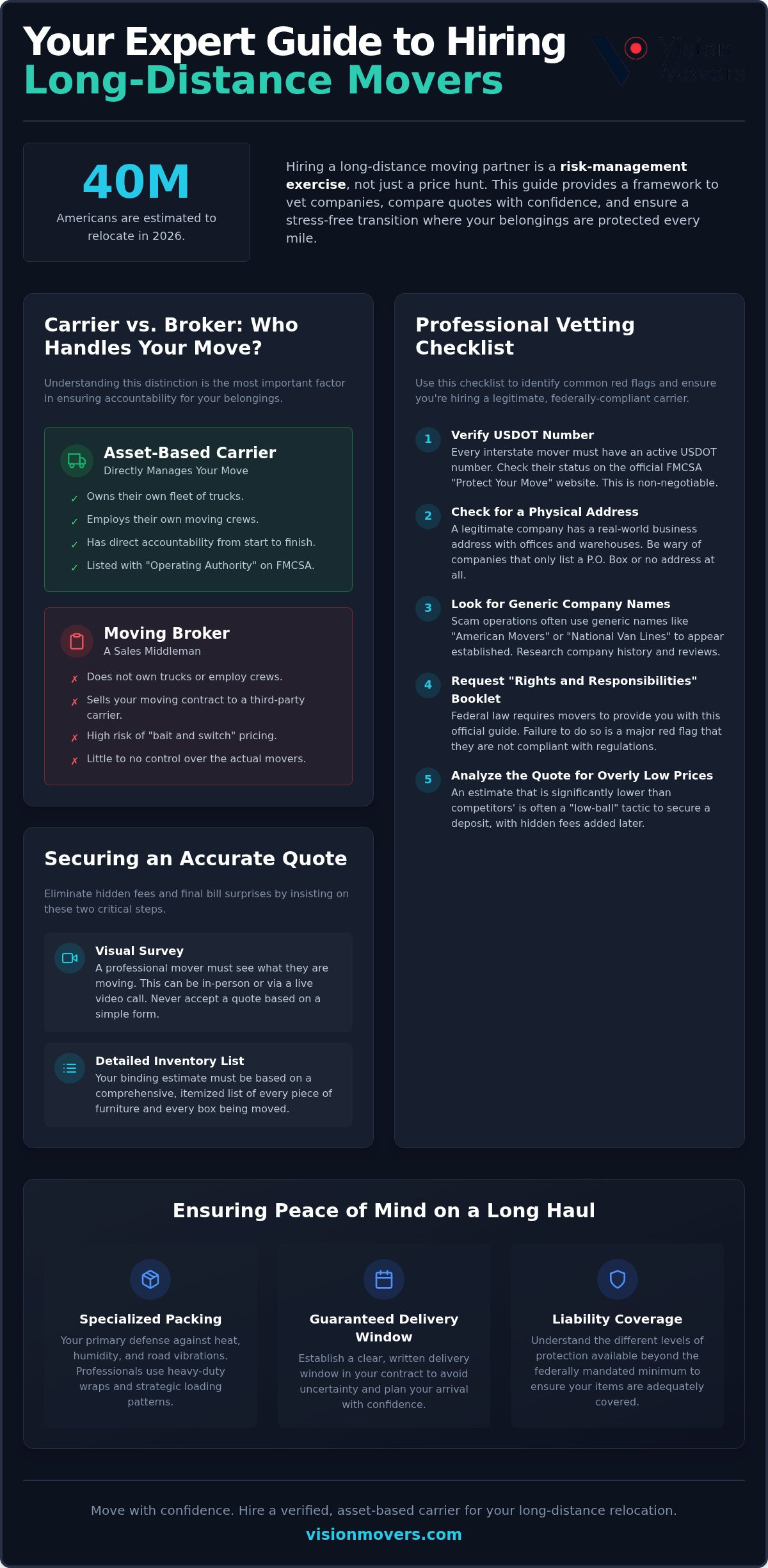
When you begin researching how to hire long distance movers, you’ll encounter two distinct business models: carriers and brokers. A carrier is a company that owns its own fleet, employs its own crews, and manages your move from the initial estimate to the final delivery. A broker, conversely, is a sales-focused entity that books your move and then auctions the contract to a third-party carrier. While brokers can sometimes provide options, they don’t actually own trucks or perform the physical labor themselves. This distinction is the most important factor in determining who is actually responsible for your furniture once it leaves your driveway.
Verifying a company’s status is a simple but vital step. You can check any company’s USDOT number on the official Protect Your Move website. As of January 16, 2026, federal rules require brokers to maintain a $75,000 surety bond, but this financial requirement doesn’t replace the operational transparency of a direct carrier. A legitimate carrier will have “Operating Authority” listed, while a broker will be classified as a “Broker of Household Goods.”
The Risks of the Broker Model
The primary risk of using a broker is the potential for a “bait and switch” pricing scenario. Brokers often provide low estimates to secure a deposit, only for the actual moving crew to demand a higher price upon arrival because they aren’t bound by the broker’s initial quote. This creates a stressful situation where your belongings are already on a truck, and you have little leverage. Additionally, filing a claim for damaged items becomes a logistical nightmare. The broker will often point to the carrier, while the carrier claims the broker mismanaged the inventory list. This lack of a single point of contact can leave you without recourse during a cross-country trip.
The Benefits of Hiring a Direct Carrier
Working with a direct carrier offers a level of accountability that brokers simply cannot match. When the company that gives you the quote is the same company that loads the truck, there is no room for miscommunication. You’ll benefit from consistent training standards, as the crews are internal employees rather than random contractors. This is a key part of Navigating the Complexities of Long Distance Moving successfully. You also gain direct access to the driver and the dispatcher, providing real-time updates on your shipment’s progress. For a more reliable experience, choosing a full-service carrier ensures that the team handling your delicate items is fully vetted and professionally trained.
The Art of the Moving Estimate: Comparing Quotes Accurately
Accuracy in a moving quote starts with a visual inspection of your home. Whether a company performs an in-home walkthrough or a detailed virtual survey, they must see your inventory to provide a reliable price. This is a fundamental step in learning how to hire long distance movers who won’t surprise you with extra costs later. A company that offers a firm price over the phone without seeing your belongings is likely cutting corners or preparing to increase the price on move day. The inventory list is the most important part of your contract because it serves as the official record of what is being moved.
Several factors influence the final cost of an interstate relocation. While weight and distance are the primary drivers, “accessorial” services often make up a significant portion of the total. These services include professional packing, unpacking, and the handling of heavy items like pianos or safes. You can learn more about these line items by reviewing How to Understand and Compare Professional Moving Quotes. Identifying these costs early helps you compare different companies on an even playing field.
Binding vs. Non-Binding Estimates
Understanding the legal structure of your estimate is vital for financial protection. Not all quotes offer the same level of certainty, and the type of estimate you choose dictates your final bill. There are three common types of estimates used in the industry:
- Binding Estimate: This guarantees a set price based on a fixed inventory list. If the weight of your goods is higher than estimated, the price doesn’t change as long as the inventory remains the same.
- Binding-Not-to-Exceed: Often called the “gold standard,” this ensures you won’t pay more than the estimate. If your shipment weighs less than predicted, you actually pay a lower price.
- Non-Binding Estimate: These are risky for long-distance moves. The final cost is determined by the actual weight of the truck, which means your bill could skyrocket if the initial guess was low.
Understanding Moving Valuation (Insurance)
Standard liability coverage for interstate movers is called Released Value Protection. By federal law, this only covers 60 cents per pound per item. If a 100-pound television is damaged, you would only receive 60 dollars in compensation. For most households, Full Value Protection is the better choice. This option requires the mover to repair, replace, or provide a cash settlement for the current market value of any lost or damaged items. Before you sign your contract, review the official Your Rights and Responsibilities When You Move booklet. It outlines your legal protections regarding valuation and helps you decide how to protect your high-value belongings during their cross-country journey.
Vetting Your Mover: A Comprehensive Checklist of Red Flags
Protecting your household goods starts with a healthy dose of skepticism. When you are researching how to hire long distance movers, you must look past a polished website and verify the actual physical operation. Start by entering the company’s address into Google Street View. If the location is a P.O. Box, a residential home, or a vacant lot, it’s a significant red flag. A legitimate carrier should have a physical yard for their trucks and a professional office for their staff. You can also perform the “Generic Phone Greeting” test. If a representative answers with a vague phrase like “the movers” instead of their specific brand name, they’re likely a broker or a small operation that lacks accountability.
Before you commit to a deposit, check the Better Business Bureau (BBB) and the FMCSA’s complaint database. Look specifically for reports of “hostage loads,” which is a predatory tactic where movers refuse to unload your belongings until you pay an unquoted fee. Review every page of your contract carefully. You should never sign a document that has blank spaces or missing signature lines; these can be filled in later with terms you didn’t agree to. If you want a partner who prioritizes transparency, you can request a detailed quote from an established carrier today.
Digital and Reputation Vetting
Spotting fake reviews is a critical skill in the modern moving industry. Be wary of companies that have dozens of five-star reviews posted within the same 48-hour window, as these are often purchased. Look for detailed accounts of the moving process rather than generic praise. Longevity is another indicator of quality. For example, Vision Movers was founded in 2016, providing a multi-year track record of successful interstate transitions. You should also verify if the company is part of the American Trucking Association (ATA) ProMover program, which requires members to adhere to a strict code of ethics and professional conduct.
The 30-Day Vetting Timeline
A structured approach is the best way to manage the stress of a cross-country move. Following a timeline ensures you don’t overlook critical details in the final rush. Use this 30-day framework for your vetting process:
- Day 30: Request at least three in-home or virtual estimates to establish a price baseline.
- Day 20: Verify the USDOT numbers and insurance certificates for your top choices.
- Day 10: Finalize your inventory list and receive a signed, written contract from your chosen mover.
This methodical progression allows you to identify potential issues while you still have time to change your plans. By the time you reach the 10-day mark, you should have total confidence in your mover’s ability to handle your transition with care and professionalism. Taking these steps early ensures that your belongings are in safe hands long before the truck arrives at your door.
Finalizing Your Decision: Why South Florida Expertise Matters
When you are researching how to hire long distance movers, the geographic origin of your carrier is just as important as their safety rating. Moving out of South Florida presents unique environmental and logistical challenges that generic national companies often overlook. The intense humidity and heat of the region can wreak havoc on delicate wood furniture and sensitive electronics if they aren’t staged and packed correctly. Expert movers from the area understand that items traveling from a tropical climate to a cooler or drier state require specialized full-service packing. This extra layer of protection acts as a buffer against the varying climate zones your shipment will cross during its journey.
Logistics also play a major role in a successful departure. Navigating a long-distance move from a high-rise in Brickell or a busy street in Miami requires precise timing and specialized equipment. A company with local roots knows how to manage tight elevator windows, strict building associations, and the narrow streets of South Florida’s urban cores. Having a local point of contact in Fort Lauderdale or Boca Raton before you leave provides an added layer of accountability. It’s much easier to finalize details with a team that has a physical presence in your community, ensuring that your transition begins with a sense of calm and organization.
Specialized Handling for High-Value Items
Interstate relocations subject your belongings to thousands of miles of road vibration and shifting. This is why standard moving techniques aren’t enough for heavy or high-value items. Pianos, safes, and heirloom furniture require advanced stabilization methods to survive the trip. For instance, Piano Moving in 2026: Why Professional Expertise is Non-Negotiable highlights how specialized equipment prevents internal damage during long-haul transit. Our teams use specific furniture protection techniques, including custom crating and heavy-duty padding, to ensure your most prized possessions arrive in the same condition they left.
Choosing Vision Movers for Your Long-Distance Journey
Vision Movers bridges the gap between your life in Florida and your new destination with a focus on white-glove service. We take pride in our South Florida heritage and our status as a full-service carrier. You won’t have to worry about the uncertainty of a broker or the stress of hidden fees. We provide transparent, binding-not-to-exceed quotes that give you a clear financial roadmap for your relocation. Our commitment to disciplined, organized, and transparent communication is what sets us apart as a trusted partner in your transition. When you’re ready to take the next step, get a detailed long-distance moving quote from Vision Movers and experience the peace of mind that comes with professional expertise.
Securing Your Cross-Country Transition with Confidence
Success in an interstate relocation depends on your ability to distinguish between asset-based carriers and sales-focused brokers. By prioritizing a binding-not-to-exceed estimate and insisting on a visual inventory, you protect your budget from unexpected surcharges. Mastering the art of how to hire long distance movers is ultimately about choosing a partner who provides accountability through every mile. You now have the framework to vet companies effectively, ensuring your belongings are shielded from the rigors of transit and climate shifts.
Vision Movers brings professional stability to your journey with an A+ BBB Rating and full FMCSA licensing. Our team provides specialized white-glove furniture protection and deep expertise in South Florida logistics to ensure a seamless departure from the region. Whether you’re moving a full household or high-value items like pianos and safes, we’re here to handle the heavy lifting with care and precision. Plan your stress-free long-distance move with Vision Movers today. Your new home is waiting, and we’re ready to help you get there safely.
Frequently Asked Questions
How much do long distance movers typically cost in 2026?
Long-distance moving costs are determined by the total weight of your shipment and the mileage of the journey. Every move is unique, so the total investment varies based on your specific inventory and the distance to your new home. Factors like professional packing services and storage will also influence your final quote. Because every household has different requirements, getting a binding-not-to-exceed estimate is the best way to secure a transparent price that fits your specific needs.
What is the difference between a moving carrier and a moving broker?
A moving carrier is an asset-based company that owns its trucks and employs its own crews to handle your relocation directly. A moving broker is a sales entity that books your move and then outsources the physical labor to a third-party carrier. Choosing a carrier ensures better accountability and a single point of contact. This distinction is vital when learning how to hire long distance movers, as carriers maintain direct control over your belongings throughout the entire trip.
How far in advance should I hire long distance movers?
You should aim to hire your moving team at least eight to twelve weeks before your scheduled departure date. Booking early is especially important if you are moving during the peak summer months or over a holiday weekend when capacity is limited. Securing your date two to three months in advance allows plenty of time for a visual inventory survey. It also ensures you have a confirmed delivery window, which provides much-needed peace of mind during a complex relocation.
Are long distance movers required to be licensed and insured?
Yes, all interstate moving companies must be registered with the Federal Motor Carrier Safety Administration (FMCSA) and maintain an active USDOT number. This registration proves the company meets federal safety standards and carries the required insurance for public liability and property damage. You can verify a company’s credentials on the FMCSA’s SAFER website. Working with a licensed carrier ensures your move is governed by federal consumer protection laws, including specific requirements for liability and dispute resolution.
How do I avoid moving scams when hiring long distance movers?
Avoiding scams requires verifying a mover’s physical address and checking their complaint history on the FMCSA’s website. Be wary of companies that demand a large cash deposit upfront or provide an estimate without seeing your inventory. Learning how to hire long distance movers involves mastering the vetting process, which includes checking for an A+ BBB rating and ensuring the company uses a brand-specific phone greeting rather than a generic one. Always insist on a written, signed contract.
Will my long distance movers also provide storage if my new home isn’t ready?
Many full-service carriers provide secure storage services for customers whose new homes aren’t quite ready for move-in. This is often referred to as “storage-in-transit,” where your belongings stay on the truck or in a local warehouse for a set period. Choosing a mover that offers integrated storage simplifies your logistics, as the same crew remains responsible for your items. This eliminates the risk of damage that can occur when moving items between different facilities or providers.
Can I pack my own boxes for a long distance move to save money?
You can pack your own boxes to reduce costs, but it’s important to understand the trade-offs regarding liability. Most movers will not accept liability for the contents of “Packed by Owner” (PBO) boxes unless there is visible damage to the exterior of the carton. For fragile or high-value items, professional packing services are highly recommended. These experts use specialized techniques to protect your furniture from the vibrations and climate shifts encountered during a multi-day interstate journey.
What items are long distance movers not allowed to transport?
Federal regulations and safety policies prohibit movers from transporting hazardous, flammable, or explosive materials. This includes items like propane tanks, gasoline, aerosol cans, and certain household cleaning chemicals. Most carriers also decline to move perishable food items or living plants, as they cannot survive the duration of a long-haul trip. For your own security, you should personally transport “high-value” items such as jewelry, cash, and important legal documents rather than packing them in the moving truck.
Leave a Reply