
A studio move isn’t priced by square footage alone. The cost to move a studio apartment in Miami depends on what you’re taking, the distance between addresses, and whether stairs, elevator reservations, parking, or a long carry add time and coordination. Two quotes for similarly sized apartments may cover different work.
If you’re concerned about unclear pricing or unexpected charges, look beyond the estimate’s bottom line. Understanding what details shaped the quote and which services it includes makes it easier to compare options.
This guide explains the main factors movers consider, including inventory, building access, timing, and optional packing. You’ll also learn how to compare written estimates for equivalent services and what to confirm with your building before moving day. With those details in hand, you can request a move-specific quote and plan your Miami studio move with less guesswork.
Key Takeaways
- The cost to move a studio apartment in Miami depends on the details of the move. Start with a clear inventory and both addresses.
- Before setting your move plan, check elevator reservations, loading areas, insurance paperwork, and move windows with building management.
- Compare written estimates using the same inventory, access details, and service scope. Check what each estimate includes or excludes.
- Packing and furniture protection are optional services. Confirm whether they’re included in the estimate or listed separately.
- Clear information and early coordination can help prevent avoidable quote changes. Learn what to confirm when choosing a mover for your Miami studio.
What Determines the Cost to Move a Studio Apartment in Miami?
A moving quote depends on the details of the move, not just the word “studio.” The cost to move a studio apartment in Miami can vary with the belongings being moved, the distance between addresses, building access, timing, and requested services. There isn’t one rate that applies to every studio. A useful estimate starts with a clear picture of the work involved.
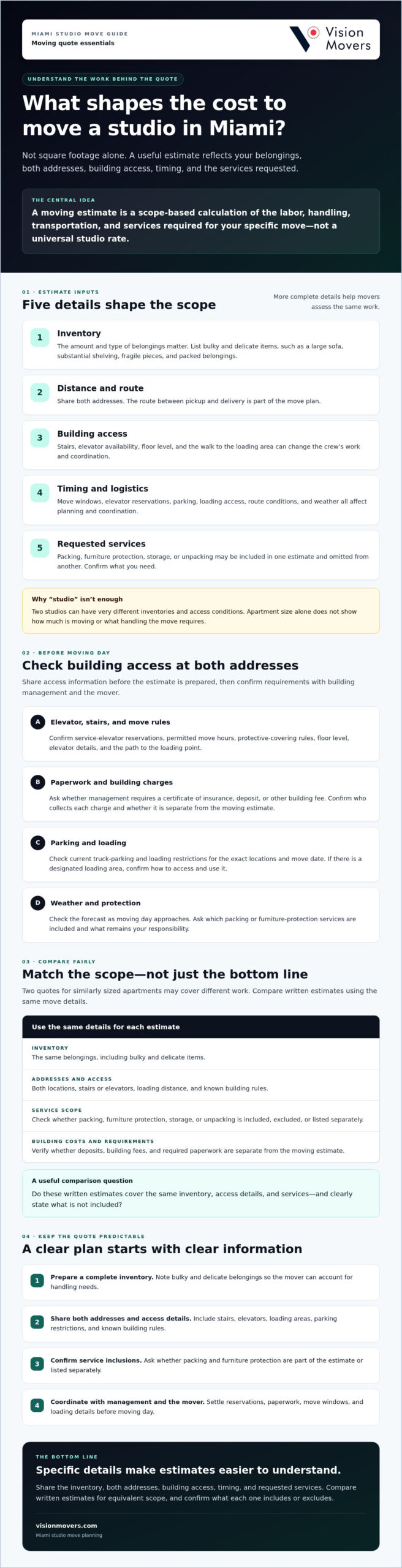
A moving estimate is a scope-based calculation of the labor, handling, transportation, and services required for your specific move, not a universal studio rate. That scope reflects the practical steps involved in a relocation process, from preparing belongings to moving them between homes.
Which details shape a studio move estimate?
Inventory is a key starting point. A few boxes and light furniture require different handling and truck-space planning than a studio with a large sofa, substantial shelving, fragile pieces, or many packed belongings. List bulky and delicate items so the mover can account for how they need to be handled.
Distance and access matter, too. Stairs, elevator availability, the walk from your unit to the loading area, and the route between pickup and delivery can affect the crew’s work. Requested services also change the scope. Packing, furniture protection, storage, or unpacking may be included in one estimate and omitted from another. Confirm what you need rather than assuming it’s part of the quote.
Why apartment size alone cannot predict the final quote
Two studios can have very different moving needs. A lightly furnished unit with a short, direct path to the truck may be straightforward to plan. A smaller space filled with dense furniture, fragile belongings, or carefully packed boxes may require more handling. The apartment’s label doesn’t tell a mover how much is being moved or what access will involve.
Building logistics can add coordination even when the home is compact. An elevator that must be reserved, stairs, or a distant loading area can affect the move plan and the time needed. Before requesting estimates, prepare a complete inventory, share both addresses, and describe access at each location. Include any building rules you know. Accurate details help movers assess the same scope and make estimates easier to compare.
How Miami Building Access Can Change a Studio Move
A small apartment can still require careful coordination. Apartment and condominium rules may limit when a crew can arrive, which entrance they can use, and how belongings move from the unit to the truck. These details affect scheduling and the move plan, so share building access information before a mover prepares an estimate. That gives the mover a clearer picture of the work and helps avoid leaving important logistics until moving day.
Elevators, stairs, and condominium move requirements
Ask building management whether you need to reserve a service elevator, follow permitted move hours, provide a certificate of insurance, or arrange protective coverings. Confirm any deposit or building fee, who collects it, and whether it is separate from the moving estimate. Don’t assume the mover pays building charges or that the estimate includes them.
Tell the mover the floor number, whether stairs are involved, and the distance from your unit to the loading point. If you know the elevator dimensions, share them, especially if you have bulky furniture. A reserved elevator and nearby loading area call for a different plan than stairs or a long walk through the building. Confirm requirements with both management and the mover.
Miami traffic, weather, and parking logistics
Route conditions and arrival windows can affect coordination between pickup and delivery. Confirm legal truck parking and loading access at both addresses, and check current restrictions for the exact locations rather than relying on what was allowed during a previous visit. If your building has a designated loading area, ask how to access and use it.
Check the forecast as moving day approaches. Rain and heat can affect how you prepare belongings for loading and protect them during handling. Ask the mover what packing or furniture-protection services are included, if any, and what remains your responsibility. Treat these as scope details to settle before the crew arrives.
- Confirm elevator bookings, allowed move hours, and protection rules.
- Ask management about certificates of insurance, deposits, and other building charges.
- Share stairs, floor level, elevator information, and the route to the loading point.
- Check parking and loading restrictions at both addresses for your move date.
Clear access details make the cost to move a studio apartment in Miami easier to assess, but only the written estimate shows how those details affect the quoted scope. For interstate moves, the Federal Motor Carrier Safety Administration’s Your Rights and Responsibilities When You Move guide explains consumer information relevant to that type of relocation.
If you’re planning a local or residential move in Miami, review Vision Movers’ local moving services and ask about availability for your address and date.
How to Compare Miami Studio Moving Quotes Fairly
A low total doesn’t tell you whether an estimate covers the same work as another. To compare the cost to move a studio apartment in Miami fairly, request written estimates using the same inventory, pickup and delivery addresses, access details, move date, and requested services. Review the scope line by line, not just the final figure.
What to check in each written estimate
Make sure each estimate identifies the move date, both addresses, the belongings being moved, and the services included. Check how the mover describes the estimate type, payment terms, and circumstances that could change the scope or final amount. If something is unclear, ask for an explanation in writing before choosing.
Use a simple comparison like this to spot differences:
| Estimate item | What to compare |
|---|---|
| Labor | Crew and work covered, including loading and unloading |
| Travel | How transportation or travel time is described |
| Packing | Whether packing labor and supplies are included or separate |
| Protection | Whether furniture protection is included and what it covers |
| Access | How stairs, long carries, or building restrictions are treated |
| Estimate terms | Estimate type, payment terms, and how scope changes are handled |
Don’t assume a service is included because it came up in a conversation or appears on a general service list. Ask whether the written estimate covers it and whether an additional service or charge could apply. Keep building charges separate from the mover’s estimate, and confirm who collects them.
Questions that help reveal quote differences
Ask each mover: “What information could change this estimate before or on moving day?” Follow up about special handling, stairs, long carries, and building restrictions. Confirm whether packing supplies, furniture protection, loading, and unloading are included, optional, or outside the quoted scope. These questions are especially useful when one estimate appears simpler than another.
A moving quote may not cover every expense around a relocation. For a broader budgeting checklist, Forbes discusses common moving expenses beyond the mover’s fee. For additional questions to consider while evaluating companies, see this local moving service selection guide.
After comparing equivalent services, choose the estimate whose written scope and terms you understand. If an important detail is missing, ask for clarification before confirming the move.
How to Keep a Miami Studio Move Quote Predictable
A predictable quote starts with a clear sequence: document your belongings, check building requirements, choose the services you need, review the written estimate, and confirm the plan. Sharing accurate details early can reduce avoidable changes, though it can’t guarantee a lower price or prevent every change. The goal is to have the estimate reflect the move you’re actually planning.
A practical pre-quote checklist
Before requesting estimates, gather the information a mover needs to understand the scope. Separate essential services from optional help so you can see how each choice affects the written plan.
- List your belongings: Note furniture, boxes, fragile items, and anything that may need special handling.
- Record access details: Share both addresses, floor levels, elevator access, parking arrangements, and building move rules.
- Choose your services: Decide whether professional packing, furniture protection, or unpacking support fits your needs. Ask whether each is included or optional.
Discuss storage if your move-in timing or access arrangements create a gap between pickup and delivery. If so, review moving and storage options and confirm whether the service fits your schedule.
Confirm the plan before moving day
Once you’ve reviewed the estimate, get the agreed services, schedule, estimate assumptions, and contact details in writing. Check that the document reflects the inventory and building information you provided. If anything is unclear, ask for clarification before confirming rather than relying on a verbal understanding.
Keep your estimate details handy and update the mover if your inventory, access, date, or building instructions change. A new piece of bulky furniture or a change to elevator access can affect the plan. Prompt updates give everyone a chance to review the scope and confirm any revised terms before moving day.
These steps can make the cost to move a studio apartment in Miami easier to plan for by reducing uncertainty about what’s included, not by promising a particular price. Vision Movers provides local and residential moving services in South Florida, with professional packing and furniture protection available. Confirm availability for your address and date, along with the estimate’s terms. Learn about requesting a move-specific estimate from Vision Movers.
Choosing Miami Movers for Your Studio Apartment
The right mover for a studio move is one who can explain the plan clearly, put the agreed scope in writing, and account for the access details you’ve shared. A compact home can still involve stairs, elevator coordination, heavy furniture, or substantial packing. Look for answers to your specific questions rather than relying on a generic description of a studio move.
Vision Movers provides local and residential moving services in South Florida, including Miami. Professional packing and furniture protection are available options, but they aren’t assumed to be part of every move. Confirm which services suit your belongings and whether they appear in the written estimate. The cost to move a studio apartment in Miami is easier to assess when you know what handling and support the estimate covers.
When professional movers may fit a studio move
Consider the time and effort involved in moving your belongings yourself. Stairs, elevator logistics, heavy furniture, and the amount of packing can all shape the work, even if the apartment has a small floor plan. Professional help may be worth considering if managing those tasks alone would be difficult, but it isn’t automatically cheaper or the best fit for everyone. Compare the options with your needs and the written scope in mind.
What to share when requesting a Miami moving estimate
Give the mover enough detail to assess your actual move. Share your intended date, pickup and delivery addresses, an inventory of belongings, floor levels, elevator details, and parking information. Mention building rules or access limits you’ve confirmed. If you’re considering packing, furniture protection, storage, or unpacking, say so and ask whether each option can be included in the estimate.
Before booking, make sure you understand the services, estimate assumptions, schedule, and conditions that could affect the plan. Ask about unclear items and confirm current availability for your address and date. A clear conversation helps both sides establish what you’re requesting without pressure to choose services you don’t need.
If you’re planning a Miami studio move, share your details and ask what information is needed to prepare a move-specific estimate. Talk with Vision Movers about your Miami move.
Plan Your Miami Studio Move with Confidence
The clearest way to understand the cost to move a studio apartment in Miami is to get an estimate based on your belongings, access requirements, and chosen services. Compare written quotes for the same scope, and confirm building arrangements before moving day. These steps help you make an informed decision and reduce avoidable surprises.
Vision Movers is a South Florida moving company providing local and residential moving services, with professional packing and furniture protection available as options. Share your move details and ask about availability, estimate terms, and which services fit your needs before booking.
For a move in Miami, Fort Lauderdale, Boca Raton, Brickell, Weston, Plantation, Pompano Beach, Broward County, Hollywood, Dania Beach, Coral Springs, or Parkland, request a move-specific estimate from Vision Movers. A clear inventory and building-access details help ground the plan in the specifics of your move.
Frequently Asked Questions
How much does it cost to move a studio apartment in Miami?
The cost depends on your inventory, distance, building access, move date, and requested services. There isn’t one price that applies to every studio move. Share both addresses, stairs or elevator details, parking arrangements, and packing needs with movers. Then compare written estimates based on the same services and move details.
What makes a studio apartment move more expensive?
More belongings, difficult access, long carries, stairs, limited elevator hours, and extra services can change the work involved. Packing, furniture protection, storage, or special handling may also affect the estimate’s scope. Ask each mover which details are included and what could lead to a change. This helps you understand the estimate without assuming every studio move follows the same pricing formula.
Do movers charge less for a studio apartment?
Not necessarily. A studio may have fewer belongings than a larger home, but travel, labor, timing, access, and requested services still affect the move. A building with restricted move hours or limited loading access may take additional coordination. Provide an accurate inventory and address-specific details so the mover can assess the actual job rather than estimate based on apartment size alone.
How can I get an accurate moving estimate for a Miami studio?
Provide your move date, both addresses, a clear inventory, floor levels, elevator access, parking details, and any building rules. Explain whether you’re considering packing, furniture protection, or unpacking. Request written estimates using the same information and service scope, then ask how changes or additional requirements are handled. Confirm building arrangements before finalizing the move. These details help clarify the cost to move a studio apartment in Miami.
Do Miami condo buildings require a certificate of insurance from movers?
Some buildings may request insurance documentation or set rules for scheduling and access, but requirements vary by property. Ask management what documents, elevator reservations, loading arrangements, and move hours apply. Share those instructions with your mover early and confirm who will provide any requested paperwork. Don’t assume one building’s policy applies to another condo, even within the same Miami neighborhood.
Is hiring movers for a studio apartment worth it?
It depends on your time, belongings, access, physical capacity, and need for packing or furniture protection. Professional help may support loading, handling, and building coordination, while moving independently may suit a simpler situation. Consider the responsibilities and services in each option rather than judging by floor plan alone. Vision Movers provides local and residential moving in Miami and South Florida, including Fort Lauderdale, Boca Raton, Brickell, Weston, Plantation, Pompano Beach, Broward County, Hollywood, Dania Beach, Coral Springs, and Parkland. Confirm availability for your address.
When should I book movers for a studio apartment in Miami?
Contact movers once you have a likely move date, especially if your building requires an elevator reservation or has limited move windows. Availability varies, so ask directly rather than relying on a universal booking deadline. Gather your inventory and access details before requesting an estimate. As the move approaches, reconfirm the schedule, building requirements, and agreed services with the mover and building management.
Leave a Reply