
The same household can receive very different moving estimates depending on the distance and the work involved. The average moving cost in Miami-Dade isn’t one fixed figure: local and long-distance moves are priced differently, and home size, packing needs, and access also affect the estimate.
It’s reasonable to want a clear budget before moving day, but a headline average may not reflect your move. Understanding what an estimate includes helps you compare the right details and plan with fewer surprises.
This article explains how moving estimates are shaped in Miami-Dade, which factors affect the total, and why local and long-distance moves use different pricing approaches. You’ll see how labor, transportation, packing, and shipment size influence an estimate, and what information to provide for a more useful quote.
Key Takeaways
- Local moving estimates commonly reflect crew time, transportation, and the size of the move, so compare what each estimate includes.
- Minimum booking periods can affect the total even when the work itself takes less time.
- For long-distance relocations, the load and travel distance play a larger role in how an estimate is calculated.
- Packing needs, access at each home, and timing can all change the work involved and shape your moving budget.
- Knowing these pricing factors makes it easier to plan your move and understand which details matter most in a quote.
How Are Moving Estimates Calculated?
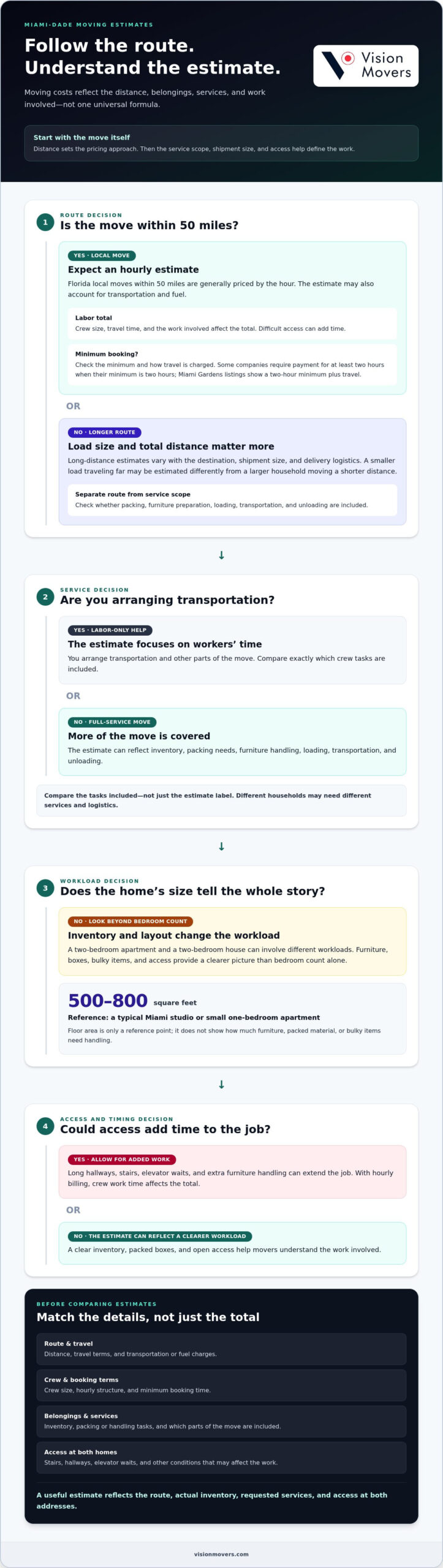
A moving estimate reflects the work, belongings, and route involved, not one universal formula. In Miami-Dade, the difference between labor-only help and full-service moving starts with which tasks the crew handles.
Local Full-Service and Labor-Only Averages
A full-service estimate covers a broader range of moving tasks, while labor-only pricing focuses on workers’ time. The distinction matters because households can need different services and logistics.
For a full-service move, the inventory, packing needs, furniture handling, loading, transportation, and unloading shape the work. Labor-only help focuses on the crew’s role, while the customer arranges transportation and other parts of the move. Compare estimates by scope, not label, to see which tasks each includes.
Moving Costs by Home Size
Home size can indicate how much furniture and how many boxes a crew will move. An apartment with fewer belongings, for example, can involve a different workload from a larger house.
Local estimates may be organized by studio, one-bedroom, two-bedroom, and larger homes. Labor-only categories may also distinguish apartment size from house size. For example, a two-bedroom apartment and a two-bedroom house can involve different workloads. Bedroom count alone may not capture the full scope.
Square footage adds another reference point, especially when a home has an unusual layout or many belongings. A typical Miami studio or small one-bedroom apartment ranges from 500 to 800 square feet. Still, floor area alone does not show how much furniture, packed material, or bulky items need handling. An estimate is more useful when it reflects the actual inventory and access at both addresses.
Distance changes the logistics as well as the work. For local moves, the route affects transportation planning, while the load influences how much space and handling the move requires. In Miami Gardens, moves of 50 or more miles are described using load size and total distance. This illustrates why estimates for nearby destinations and longer routes use different inputs.
Long-distance estimates from Miami also vary by destination. Routes to New York, Boston, Dallas, Las Vegas, and Phoenix involve different distances and delivery logistics. The destination helps define the route, but shipment size matters too: a smaller load traveling far can receive a different estimate from a larger household moving a shorter distance.
When comparing long-distance estimates, separate the route from the services requested. Packing, furniture preparation, loading, transportation, and unloading are distinct parts of the job. The estimate should make clear which tasks are included, since two households traveling to the same destination may need different services.
Use home size as a starting point, then consider the inventory, service scope, and route together. A studio, a two-bedroom apartment, and a large house each present different moving needs. Naming the destination and describing your belongings gives a clearer picture than relying on a broad category alone.
How Much Does Hiring a Moving Company Cost in Miami?
For local moves, movers commonly calculate labor by the hour and account for transportation and fuel. The estimate reflects crew size, travel time, and the work involved in handling your belongings.
How Hourly Rates Are Calculated
The hourly rate is only one part of the estimate. Transportation and fuel may also affect the total.
Crew size affects the hourly total. Companies base hourly rates on location, travel time, and the number of movers needed. A move requiring more people for lifting and carrying may have a higher labor total, while difficult access can add time. The same hourly rate can therefore lead to different overall costs.
Florida local moves within 50 miles are generally priced by the hour. That local figure offers context, but a household’s estimate still depends on its specific route, crew, and handling needs.
Minimum Booking Times and Other Charges
A minimum booking sets the shortest labor period a customer may be charged for, even if the crew finishes sooner. Some companies require payment for at least two hours when their minimum is two hours. Miami Gardens listings show a two-hour minimum plus travel, so both the minimum and travel time can affect the bill.
Before comparing estimates from providers like Vision Movers, separate labor from travel and transportation charges. Check what the hourly portion covers, how the minimum applies, and whether travel time is included. This helps you compare estimates on the same basis instead of focusing only on the hourly rate.
Timing and logistics affect the hours needed. A clear inventory, packed boxes, and open access help movers understand the workload. Long hallways, stairs, elevator waits, and extra furniture handling can extend the job. With hourly billing, these details matter because the crew’s work time affects the total.
Reviews and Hourly Rates
Reviews offer context about customers’ experiences, but they don’t determine an hourly rate or predict your move’s duration. Movers serving Miami-Dade County received 1,311 reviews in the last year, and 99% of reviewers rated them four or five stars. Those figures describe the review landscape, not a guarantee of service or a price.
Use reviews to look for recurring comments about communication, punctuality, and care with belongings. Then compare each estimate’s hourly terms and minimum booking time. Reviews and hourly rates answer different questions: one reflects customer feedback, while the other helps explain labor charges.
For a practical comparison, record crew size, hourly structure, booking minimum, travel terms, and transportation or fuel charges. Note any packing or handling tasks included as well. This side-by-side view helps you see which estimate fits your relocation needs and why totals may differ.
Factors that affect moving prices
A moving estimate reflects more than the number of bedrooms. In Miami-Dade, crew size, belongings, access, packing, storage, and timing can all change the work involved. Understanding these factors helps you compare estimates by scope and plan around your actual move, rather than relying on a broad home-size label.
Load size, crew, and access
The amount and type of furniture influence how many movers are needed and how long handling takes. A local move from a home with two or more bedrooms typically requires a three-mover crew. Homes with three or more bedrooms usually need four people. These examples show why bedroom count can affect labor planning, though the inventory matters too.
Access adds another layer of logistics. Stairs, long hallways, elevator waits, and the distance from the entrance to the truck can extend carrying time. A two-bedroom home with large furniture and limited elevator access, for example, may take more handling than a similarly sized home with a clear route. Describe both addresses accurately so the estimate reflects the conditions.
Packing, storage, and requested work
Packing changes the scope of a service moving estimate because it adds preparation alongside loading and transport. Professional packing can account for 15-30% of a moving bill. The percentage reflects how packing may contribute to the overall work, not a fixed charge. The number of items, fragile belongings, and amount of packing requested shape the task.
Storage may affect the plan when move-out and move-in dates don’t align. Market storage figures are not a moving company’s quote; they simply illustrate why timing and the volume of belongings matter when storage is needed between addresses.
Special handling can change the work involved, too. A piano, pool table, or safe requires a different plan from ordinary boxes and household furniture. Mention bulky or specialty items when describing the move. Clear details help explain which handling tasks are included and what parts of the relocation need separate planning.
Season and scheduling
Miami’s peak snowbird season runs from January through March, which can affect moving prices and availability. Summer moving rates in Florida are higher. These seasonal patterns make timing relevant when setting a budget, especially if your date is flexible. A flexible date can give you more scheduling options and help you understand how timing affects the proposed work.
Booking Florida movers 4-6 weeks ahead can help customers get better rates. Moving mid-week and during Florida’s off-season, from October to March, can save up to 20% compared with weekends and holidays. These are broad market patterns, not a guaranteed reduction. Use them as context when comparing quotes, and keep the move date consistent across estimates.
Making quotes easier to compare
For a useful comparison, describe the bedroom count, inventory, access at both homes, packing needs, storage, and preferred date. Then check whether each estimate includes the same tasks. For example, one estimate may include packing while another covers only loading and transport. Matching the scope makes price differences easier to understand.
Keep a written list of details for each moving estimate. Include the number of bedrooms, bulky furniture, stairs or elevators, and any storage period. Providing the same information in every request makes estimates easier to compare side by side and clarifies what each one covers.
Local and long-distance moving estimates
Local and long-distance moves use different estimate methods. In Florida, distance helps determine whether hourly labor or shipment weight and mileage drive the calculation.
Local moves use time and route details
Florida local moves within 50 miles are generally priced by the hour. The estimate accounts for the crew’s work and the route between addresses. For example, a move within Miami may involve a short journey but still require substantial loading and unloading. Distance alone doesn’t describe the full job.
Transportation for local moves is typically charged as one hour. The estimate may therefore include travel alongside the time spent handling belongings. A route between two Miami neighborhoods differs from one crossing the county, even when the household contents are similar. Providing accurate pickup and delivery addresses helps define the route and logistics.
Local and regional moves from Miami cover a range of destinations. A move to Cape Coral differs from one to Orlando because the route changes, and the inventory and work required matter as well. To understand an estimate, separate travel from loading, unloading, packing, and other requested tasks.
Long-distance estimates weigh load and mileage
For Florida long-distance moves over 100 miles, estimates generally depend on total shipment weight and distance traveled. A cross-country move adds a longer route and different delivery logistics than a relocation within Florida. The calculation therefore considers both how much is transported and how far it must go.
Compare routes from Miami to destinations such as New York, Dallas, Boston, and Phoenix. Each changes the mileage and route planning. Shipment size matters too: a small apartment’s belongings create a different load from a larger household’s furniture and boxes. An estimate should reflect the actual destination and shipment, not just the phrase “long-distance move.”
Distance also distinguishes regional moves from cross-country relocations. Orlando is within Florida, while New York and Phoenix are out-of-state destinations. These examples show why one average cannot explain every estimate. Route, load size, and requested services work together to shape the calculation.
Compare estimates by scope
Gather at least three quotes and compare them on consistent terms. Give each company the same origin, destination, inventory, and service details. Describing a large cabinet, fragile items, or packing needs can clarify what the crew must handle. Consistent information makes differences between estimates easier to understand.
Check whether each estimate includes transportation, loading, unloading, and packing. If one includes packing and another does not, the totals represent different scopes. The same applies to storage or special handling. A clear comparison helps you see which plan fits your relocation and budget, rather than treating the lowest figure as equivalent.
For a more affordable plan, focus on matching the service scope to the move rather than removing essential details from the estimate. A local move within 50 miles follows a different pricing basis from a Florida move over 100 miles. Understanding that distinction helps you read quotes accurately and plan for the work your route and belongings require.
Vision Movers: Local Moving
Vision Movers supports local and residential moves with professional packing, furniture protection, and expert loading and unloading. For a move in Miami-Dade, these services help with the practical work of preparing belongings and moving them between homes.
Vision Movers also handles interstate and commercial relocations. The right service depends on whether you’re moving a household nearby, relocating across state lines, or moving a business. Share your route, inventory, and requested tasks to discuss a plan that fits your move.
For support with your local move, contact Vision Movers to discuss your relocation.
Plan Your Next Move With Confidence
Use your estimate as a planning tool, not just a final figure. Before choosing a moving date, decide which tasks you want handled and what matters most for your household. That clarity turns the average moving cost in Miami-Dade from a broad search into a practical starting point for your own move.
Vision Movers offers local, residential, and interstate moving for different relocation needs. Whether you’re moving within Miami-Dade or leaving Florida, sharing your route and priorities helps shape a plan for your move.
Take the next step and contact Vision Movers about your move. With a clearer plan, you can move forward feeling organized and ready for what comes next.
Frequently Asked Questions
What Determines the Cost of Movers in Florida?
Move size, travel distance, crew requirements, and requested services shape moving costs in Florida. A household with more belongings may need additional loading time or truck space, while a longer route changes transportation planning. Access matters too: stairs, elevators, and long carries can add handling time. Two homes with the same bedroom count can require different work if one has bulky furniture or difficult access.
What Services Impact Moving Prices the Most?
Packing can have a substantial effect, accounting for 15-30% of a moving bill. The amount depends on how many belongings need preparation and the packing work requested. Storage can add another cost when move-out and move-in dates don’t align. Special handling also changes the work involved.
What Is the Best Way to Save Money on a Move?
Compare at least three quotes using the same inventory, addresses, and requested services. This helps reveal whether estimates cover equivalent work. Booking Florida movers 4-6 weeks ahead can help customers get better rates, and moving mid-week can offer another scheduling option. Reducing belongings before packing can also mean fewer items to handle and transport. Flexible dates may give you more room to compare available plans.
What Unexpected Costs Can Come Up During a Move?
Expenses outside a moving estimate can include packing supplies, storage, and building-related fees. These are separate market expenses, not mover prices.
What Is the Average Cost of Hiring Movers in Miami-Dade County?
These figures describe different services, so they aren’t direct like-for-like prices. Full-service moving generally covers more of the relocation work, while labor-only focuses on moving labor. Your inventory, route, access, and requested tasks influence how an estimate compares with either average.
How Much Do Local Movers in Miami-Dade Charge per Hour?
Some companies require payment for at least two hours when their minimum is two hours. The hourly amount alone doesn’t show the full estimate; transportation and fuel may also affect the total. Crew size and travel time help determine labor and route charges for a local move.
What Is the Average Cost of a 1-Bedroom, 2-Bedroom, or 3-Bedroom Move in Miami-Dade?
These figures vary by location and estimate scope, so bedroom count is only a starting point. The volume of belongings, access, packing needs, and distance can all change the work involved.
How Much Do Long-Distance Moves From Miami-Dade Typically Cost?
For a long-distance move, the average moving cost in Miami-Dade depends on the destination and shipment size. Market estimates are not a household quote.
Leave a Reply