
Treating an interstate relocation as a simple hauling job is the fastest way to derail your company’s momentum. In reality, the most successful transitions happen when you view long distance office movers as strategic partners in your business continuity rather than just a crew with a truck. It is a common concern that moving across state lines will lead to weeks of chaos and plummeting productivity. You are right to worry about the safety of your expensive IT infrastructure and the possibility of hidden fees that weren’t in the initial quote.
We understand that your goal is a seamless transition where the only thing that changes is the address on your business cards. This guide outlines expert strategies to help you master the complex logistics of moving your operations while keeping your assets secure. You will learn how to build a cost-effective plan that avoids unexpected charges and protects your sensitive data. We also explore how to execute a move on a fixed timeline so your team stays focused on their work instead of the boxes, ensuring your business remains fully operational throughout the journey.
Key Takeaways
- Learn why distance multiplies the risks of standard commercial moving and how to protect your company from the hidden costs of productivity loss.
- Discover how to categorize high-value assets and apply the “First-In, Last-Out” principle to keep essential IT infrastructure accessible throughout the transition.
- Master the vetting process for long distance office movers to ensure your provider offers the commercial-grade insurance and white-glove care required for sensitive equipment.
- Implement a structured 60-day strategic timeline that streamlines communication with vendors and employees to guarantee a fixed-timeline execution.
- Access specialized logistics advice for South Florida businesses relocating from Miami, Fort Lauderdale, or Boca Raton to any destination in the United States.
Understanding the Stakes of Long Distance Office Relocation in 2026
Moving an entire organization across state lines is a high-stakes operation where the margin for error is razor-thin. When a transit route spans hundreds or thousands of miles, the standard risks of commercial moving don’t just increase; they multiply. Long-haul transport exposes your expensive hardware and modular furniture to sustained vibrations, varied climates, and multiple handling stages. Professional long distance office movers understand that success isn’t just about getting items from point A to point B. It’s about protecting the operational heart of your company through meticulous planning and specialized equipment.
Selecting a provider based solely on a low quote often leads to expensive hidden costs. If your servers are mishandled or your workstations aren’t correctly assembled by Monday morning, the resulting downtime can cost significantly more than the move itself. Comprehensive Relocation services prioritize the safety of your assets through professional furniture protection and specialized loading techniques designed for long-haul transit. Compliance is another critical factor. You must ensure your moving partner adheres to all Federal Motor Carrier Safety Administration (FMCSA) and Department of Transportation (DOT) requirements for interstate transfers to avoid legal bottlenecks or insurance complications.
Office Move vs. Residential Move: The Key Differences
Defining Business Continuity in a Relocation Context
Business continuity is your organization’s ability to maintain essential functions during and after the move. To understand the stakes, calculate the cost of one hour of total office downtime. This figure helps you set realistic expectations for cross-country transit times and budget for premium services that minimize risks. Experienced long distance office movers assign a single point of contact to your project. This dedicated manager oversees the entire timeline, ensuring that your team stays informed and your assets remain secure from departure to delivery. This structured approach reduces the mental load on your staff, allowing them to focus on their core responsibilities while the logistics experts handle the transition.
Strategic Planning for High-Value Office Assets
Planning for a journey that spans over 1,000 miles requires a shift in mindset. You aren’t just moving desks; you’re relocating a complex ecosystem that supports your entire staff. Professional long distance office movers categorize every asset based on its fragility and its criticality to your daily operations. High-value items like specialized servers or heavy executive furniture need specific crating solutions that standard household movers often lack. Effective Strategic Planning for High-Value Office Assets involves verifying that your provider has the physical equipment and the mental organization to manage this complexity from departure to delivery.
Use the “First-In, Last-Out” principle to organize your loading sequence. This strategy ensures that your most essential equipment, like networking hardware and core workstations, is the first thing off the truck at your new headquarters. For heavy items such as safes or pianos, long distance office movers utilize specialized lift gates and floor protection to prevent property damage. Securely managing the paper trail is equally vital. Physical records should be transported in locked, trackable containers to maintain a clear chain of custody throughout the transit. If you are planning an upcoming transition, our Commercial Moving experts can help you design a customized logistics plan.
IT Infrastructure and Server Relocation
Relocating servers across state lines involves more than just unplugging cables. It requires strict de-commissioning and re-commissioning protocols to prevent data loss. Sensitive electronics are prone to damage from static and temperature fluctuations during long-haul transit. Use anti-static packing materials and shock-absorption techniques to cushion hardware against road vibrations. If your move occurs during extreme weather months, consider climate-controlled transport to keep internal components within safe operating ranges. This level of care ensures your digital assets arrive ready for immediate installation.
Modular Furniture and Workspace Disassembly
Breaking down complex cubicle systems is a logistical puzzle. Every bracket and screw must be accounted for to ensure a smooth setup at the destination. Implement a labeling system that uses color-coded zones to match furniture to its new location. This organization allows your team to return to work faster. You can use commercial moving strategies to protect your business continuity and keep your staff productive from the moment they arrive. Our team handles the heavy lifting so your employees don’t have to.
How to Evaluate Long Distance Office Movers for Your Business
Vetting long distance office movers requires a more rigorous approach than hiring a local residential crew. You aren’t just looking for someone to lift boxes; you’re looking for a partner who understands the legal and financial stakes of interstate commerce. A key indicator of quality is the “White-Glove” standard. For corporate clients, this means a service level that includes custom crating, comprehensive floor protection, and the meticulous handling of every piece of inventory. This level of care is what separates a professional transition from a chaotic one.
Insurance is another non-negotiable factor. Standard valuation coverage often falls short for high-value business assets. You should verify that your mover carries commercial-grade insurance that specifically covers the total replacement value of your IT infrastructure. When comparing costs, always prioritize binding quotes over non-binding ones. A binding quote offers a fixed price based on a set inventory, which protects your budget from the unexpected price hikes common in interstate moving. Watch out for red flags like unusually large upfront deposits or companies that refuse to provide a physical address or DOT number.
Essential Questions for Your Commercial Moving Consultant
Your first meeting with a consultant is the time to dig into their specific operational capabilities. Ask if they have experience with specialized safe moving or other heavy-duty equipment that requires custom rigging. Inquire about their protocol for managing unexpected delays during transit. Weather or road closures can happen; a prepared mover will have a communication plan to keep you updated. Finally, ask for references from other South Florida businesses. A reputable provider should be able to point to successful transitions they’ve managed for companies in Miami or Fort Lauderdale.
The Importance of a Physical or Virtual On-Site Survey
Estimates provided over the phone are notoriously unreliable for office environments. A professional walkthrough, whether in person or via a detailed virtual tour, is the only way to catch hidden logistical hurdles. A consultant needs to see the layout to identify access challenges like narrow elevators, restrictive loading docks, or the need for specific parking permits. This survey also ensures that your quote accurately reflects the cost of specialized packing materials. Without seeing the equipment firsthand, a mover can’t guarantee a fixed-timeline execution or an accurate cost-effective logistics plan.
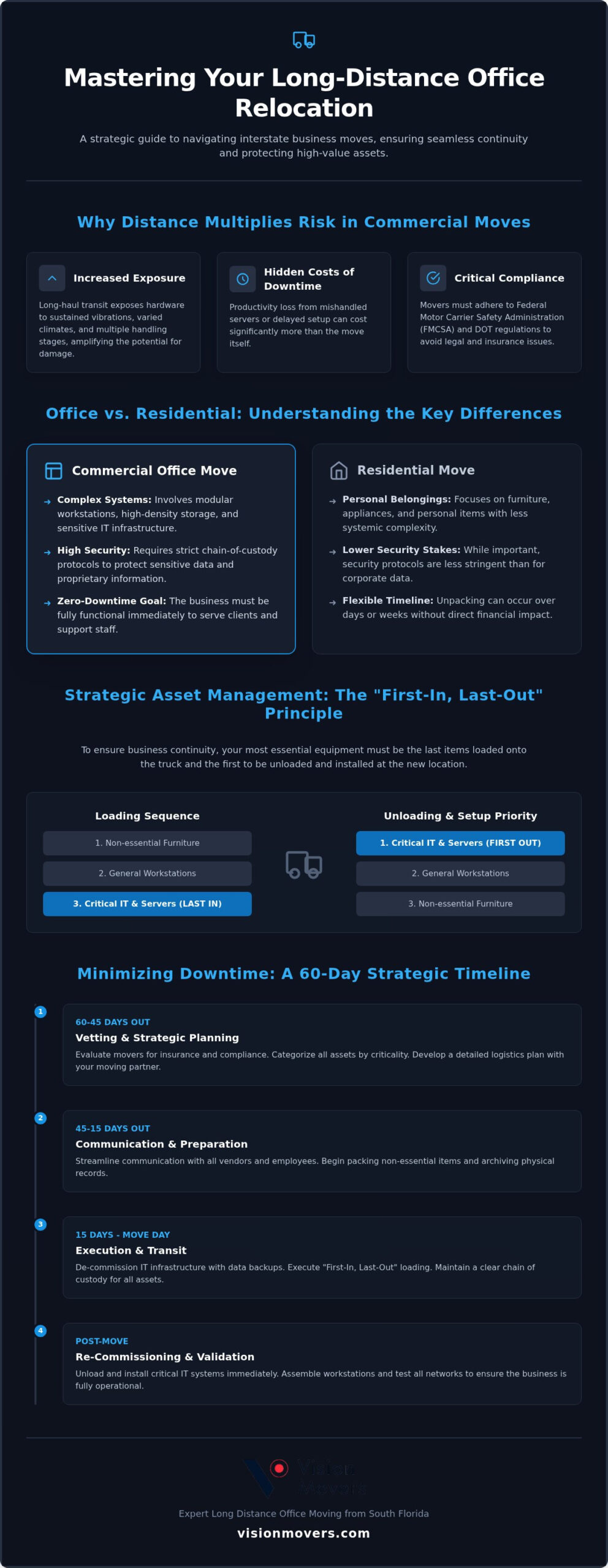
Minimizing Downtime: A 60-Day Long Distance Move Timeline
A successful interstate transition relies on a structured countdown that begins at least two months before the trucks arrive. 60 Days Out: Your priority is finalizing the relocation budget and selecting your long distance office movers. This early start ensures you secure a partner who can meet your specific timeline and asset protection requirements. 45 Days Out: Shift your focus to communication. You need to notify vendors, utility providers, and your internal staff about the upcoming change. Transparency during this phase helps manage employee expectations and reduces the stress often associated with major corporate shifts.
30 Days Out: Perform a deep inventory of every department. This is the ideal time for the “purge or move” decision. Shipping outdated files or broken furniture across state lines adds unnecessary weight and cost to your logistics plan. 15 Days Out: Transition to the technical side of the move. Conduct a final IT audit to ensure all data is backed up and begin packing non-essential archives. Focusing on these milestones early prevents the last-minute scramble that often leads to errors or damaged equipment.
The Final Week: Pre-Packing and Labeling
The last few days before departure should focus on organizational precision. Implement a color-coding system to identify which items belong to specific departments at the new location. This visual guide allows movers to place boxes in the correct zones immediately, which speeds up the unpacking process. Establish clear protocols for employee personal items; asking staff to take home their desk plants and family photos ensures these fragile items aren’t lost in the shuffle of high-volume transit. For more on short-term needs, see our moving and storage companies guide.
Day 1 at the New Location: Getting Back to Work
Your goal on the first day is to restore operational momentum as quickly as possible. Prioritize the “Core Four”: internet connectivity, coffee stations, desks, and phones. If these elements are functional, your team can begin working while the rest of the office is being organized. Professional unpacking services are often an ROI-positive investment for businesses because they allow your staff to focus on their actual jobs instead of manual labor. Finally, conduct a post-move audit. Check for transit damage immediately and document any issues to ensure your insurance claims are processed without delay. If you are ready to begin your 60-day countdown, our Long Distance Moving specialists are here to guide you through every step of the journey.
Vision Movers: Expert Long Distance Office Moving from South Florida
Relocating your headquarters from South Florida requires a partner who understands the unique logistical rhythm of the region. Since 2016, Vision Movers has served as a trusted guide for businesses transitioning from Miami, Fort Lauderdale, and Boca Raton to destinations across the United States. We don’t just haul equipment; we provide a white-glove service designed to alleviate the stress of interstate relocation. Our team brings a sense of quiet strength to every project, projecting calm competence even when managing the most complex commercial transitions. We take pride in being physically prepared and mentally organized, ensuring your company assets are handled with the highest level of care.
Safety is our primary focus during long-haul transit. We provide full-service packing and professional furniture protection to secure your investments for journeys that often exceed 1,000 miles. Our long distance office movers utilize specialized loading techniques that prevent shifting and damage on the road. By choosing a local expert with national reach, you gain the benefit of personalized support combined with the resources needed for a cross-country move. We’re committed to a successful outcome for your transition, allowing you to maintain business continuity while we manage the heavy lifting.
Serving the South Florida Business Hub
Navigating the logistics of a departure from Brickell or Downtown Miami requires specific expertise. We understand the challenges of restrictive loading docks, narrow urban streets, and strict building management requirements in Florida’s busiest districts. Our strategic planning covers departures from Broward and Palm Beach counties, ensuring that traffic patterns and local regulations never delay your timeline. We provide the local insight necessary to move your operations out of the South Florida hub efficiently, coordinating every detail so your team can stay focused on their core responsibilities.
Customized Commercial Solutions
Every business has different needs, whether you are a small boutique office or a large corporate headquarters. We tailor our logistics plans to match the scale of your organization and the sensitivity of your assets. Our specialized handling extends to heavy or fragile items that standard crews might struggle with, such as piano moving or safe relocation. This comprehensive approach ensures that every piece of your office ecosystem arrives in perfect condition. If you’re ready to secure your company’s future in a new location, you can get a professional long-distance office moving quote from Vision Movers today.
Secure Your Business Momentum Beyond the Move
Mastering the logistics of an interstate relocation is the first step toward a successful new chapter for your organization. By focusing on a structured 60-day timeline and prioritizing the protection of high-value assets, you ensure that your company’s productivity remains steady throughout the transition. The choice of long distance office movers is the final piece of the puzzle, providing the specialized equipment and logistical oversight needed to cross state lines with confidence.
At Vision Movers, we bring calm competence to every transition. Our services include professional packing and furniture protection tailored for long-haul safety, along with expert loading and unloading services. We take pride in serving the business communities of Miami, Fort Lauderdale, and the entire South Florida region with a commitment to zero data loss and fixed-timeline execution. You don’t have to manage this complex transition alone. Request Your Comprehensive Long Distance Office Moving Quote today and experience a move defined by ease and efficiency. Your next headquarters is waiting, and we’re ready to help you get there.
Frequently Asked Questions
How much does a long-distance office move typically cost?
The cost of a long-distance office move is typically determined by the total weight of your inventory and the distance of the route. According to 2026 industry data, line-haul rates generally range between $0.55 and $0.95 per pound. Additional factors like fuel surcharges and accessorial fees for elevators or long carries also influence the final total. We recommend a physical survey to get a binding quote that accounts for your specific office layout.
How far in advance should I book long-distance office movers?
You should ideally book your relocation 8 to 12 weeks in advance to ensure your preferred dates are available. This lead time is especially critical if you plan to move during the peak season between May and September, when demand for long distance office movers is highest. Starting early allows for a thorough inventory audit and gives our team time to coordinate specialized crating or IT handling requirements for your business.
Do you provide specialized packing for IT equipment and servers?
Yes, we provide specialized packing protocols specifically designed for sensitive IT infrastructure and server racks. Our team uses anti-static materials and custom crating to protect hardware from the vibrations and temperature shifts common during a 1,000-mile journey. We prioritize these high-value assets during the loading process to ensure they are the first items ready for setup at your new location, which helps in minimizing your technical downtime.
Are Vision Movers licensed for interstate commercial moves?
Vision Movers is fully licensed and compliant with all Federal Motor Carrier Safety Administration (FMCSA) and Department of Transportation (DOT) regulations for interstate commercial moves. We maintain the necessary insurance and authority to transport business assets across state lines. This professional compliance ensures your shipment is protected by federal consumer protection regulations, giving you peace of mind that your company property is in the hands of authorized experts.
How do you handle heavy office equipment like safes or industrial printers?
We use specialized rigging equipment and heavy-duty lift gates to safely manage industrial printers, large safes, and other bulky office machinery. Our crews are trained in specific weight-distribution techniques that prevent damage to both the equipment and the office flooring. By utilizing professional furniture protection and custom loading strategies, we ensure these difficult items are secured for the long-haul transit without risking the safety of the movers or your property.
What is the typical transit time for a move from South Florida to the West Coast?
A cross-country move from South Florida to the West Coast typically takes between 10 and 14 business days, depending on the specific route and weather conditions. This timeline includes the time required for careful loading, the transit distance of over 2,500 miles, and the final delivery window. We provide clear communication throughout the journey so you can coordinate your staff’s return to the office with confidence and precision.
Do you offer storage solutions if our new office is not ready?
We offer secure storage services if your new office space isn’t ready for immediate occupancy. Our facilities provide a safe environment for your workstations, electronics, and physical archives until your delivery window opens. This integrated solution allows you to vacate your South Florida location on schedule while maintaining a flexible timeline for the final setup at your destination, ensuring a seamless transition for your entire team.
How can we ensure our business data remains secure during the move?
We protect your business data through strict chain-of-custody protocols and secure, lockable transport containers for physical records. For digital assets, our long distance office movers focus on the physical security of the hardware, using specialized packing to prevent internal damage to hard drives and servers. We recommend that your internal IT team performs a full backup before departure, while we handle the logistical security of the physical devices during transit.
Leave a Reply