The most expensive mistake you can make during a relocation isn’t choosing the wrong box; it’s hiring a “rogue” broker who treats your heirloom piano like just another line item. Finding reliable movers in South Florida requires more than a quick search. It demands a climate-first strategy to protect your belongings from intense humidity and a deep understanding of strict high-rise regulations in neighborhoods like Brickell.
We understand that the thought of hidden fees or heat-damaged furniture keeps you up at night. You deserve a moving experience that’s defined by transparency and precision rather than logistical chaos. This 2026 guide provides the expert tips you need to navigate local logistics, verify licensing with the Florida Department of Agriculture and Consumer Services, and ensure your valuables arrive in perfect condition. We’ll explore the essential Tri-County Consumer Bill of Rights, specialized packing techniques for the Florida heat, and the exact steps to take for an efficient, surprise-free move that minimizes your downtime.
Key Takeaways
- Master the logistics of the Miami-Fort Lauderdale corridor, including how to plan around seasonal weather patterns and hurricane risks.
- Use our 2026 checklist to verify state registration numbers and physical addresses, ensuring you hire a legitimate direct carrier instead of a broker.
- Learn how the right movers in South Florida can help you navigate complex HOA rules and high-rise moving regulations without incurring extra fees.
- Discover specialized packing techniques designed to protect your sensitive electronics and furniture from the damaging effects of intense humidity.
- Identify strategies for both residential and commercial relocations that prioritize efficiency and the safety of heavy, high-value items.
The South Florida Moving Landscape: Why Local Expertise Matters
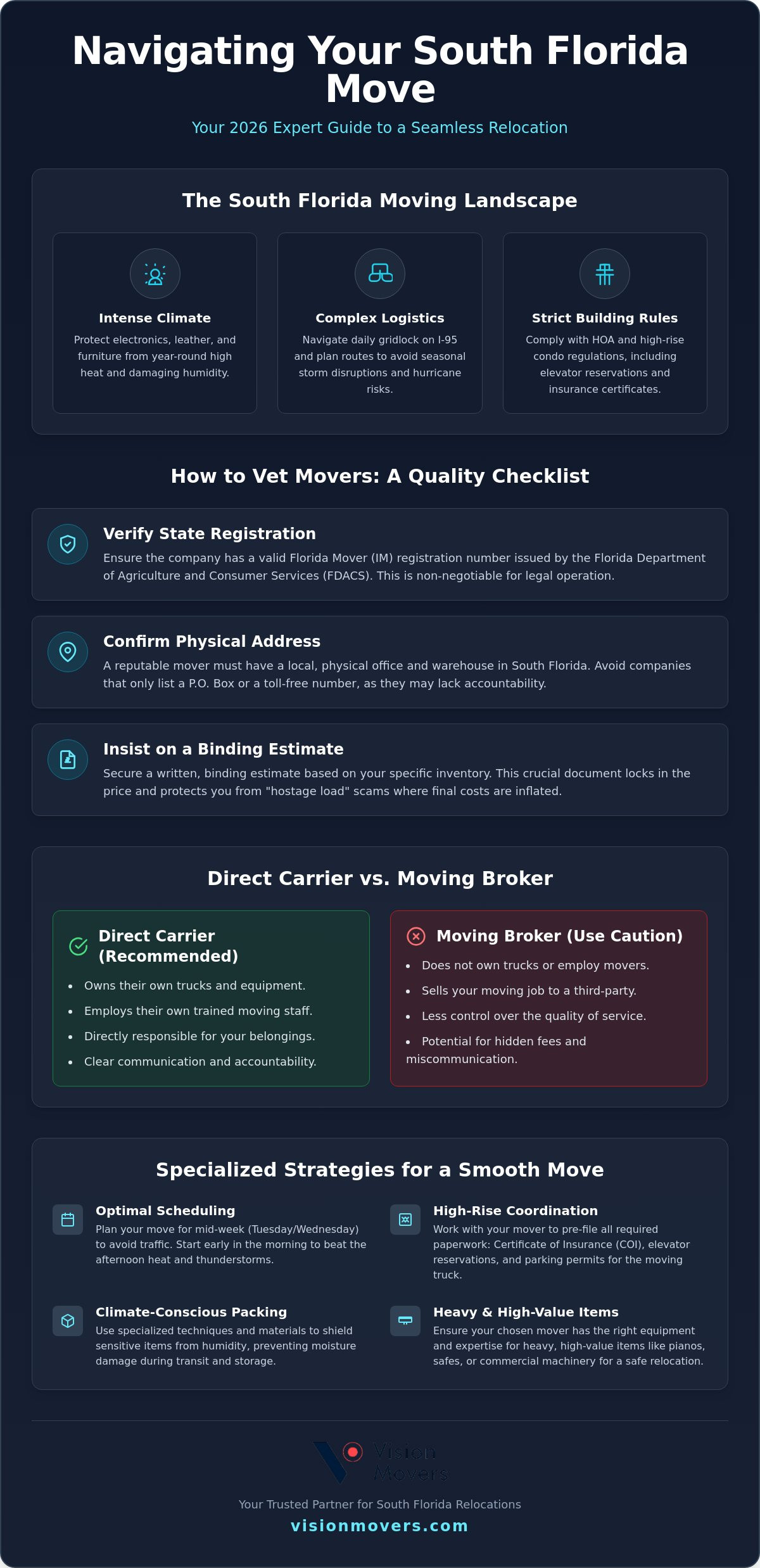
Relocating within the Miami-Fort Lauderdale-West Palm Beach corridor presents challenges that generic national companies often overlook. It isn’t just about the distance; it’s about the environment. South Florida’s geography creates a unique mix of urban density and suburban sprawl. You might be moving from a quiet cul-de-sac in Weston to a 40th-floor unit in Brickell. These two environments require completely different logistical approaches. A team that doesn’t understand the physical layout of these neighborhoods can quickly fall behind schedule.
Professional movers in South Florida must also be climate experts. Between June and November, hurricane season can disrupt even the most organized plans. Beyond the storms, the daily heat and humidity pose a constant threat to your belongings. High temperatures can cause leather to crack or electronics to fail if they aren’t handled with care. Understanding the nuances of the moving industry in this region means knowing that a “standard” move doesn’t exist here. Every relocation requires a strategy tailored to the specific humidity levels and building types involved.
Navigating Traffic and Timing in Miami-Dade and Broward
Punctuality is a hallmark of a professional team, but the I-95 and Palmetto Expressway have their own ideas. Gridlock is a daily reality in South Florida. Experienced teams plan their routes around peak congestion times to avoid unnecessary delays. We typically recommend scheduling your move for mid-week, such as a Tuesday or Wednesday. Traffic is often lighter then, and you’ll avoid the weekend rush at most residential complexes. Early morning starts are also preferable to beat the intense afternoon heat and the unpredictable thunderstorms that are common during the summer months.
Understanding Local Regulations and HOA Requirements
If you’re moving into a luxury condo in Parkland or Boca Raton, you’ll likely face strict Homeowners Association (HOA) rules. These aren’t just suggestions; they’re enforced requirements. Most buildings require a Certificate of Insurance (COI) that names the association as an additional insured. You’ll also need to coordinate several logistics in advance:
- Elevator Reservations: Many high-rises only allow moving during specific four-hour windows and require padding to be installed.
- Parking Permits: Securing a spot for a large moving truck in a crowded downtown area requires prior authorization from the city or building management.
- Gated Community Protocols: Some neighborhoods in Broward County have restricted hours for commercial vehicles, meaning movers must depart by a specific time.
Local movers in South Florida know these protocols inside and out. They ensure all paperwork is filed days in advance, preventing a situation where you’re turned away at the gate on moving day. This level of preparation provides the peace of mind you need for a successful transition.
How to Vet Movers in South Florida: A 2026 Quality Checklist
Hiring the wrong team can turn a fresh start into a logistical nightmare. In Florida, the moving industry is strictly regulated to protect consumers from predatory practices. Your first step should always be verifying the company’s Florida Mover (IM) registration number. This number is issued by the Florida Department of Agriculture and Consumer Services. If a company cannot provide this or isn’t listed in the state’s official database, they’re operating illegally. Legitimate movers in South Florida will proudly display this credential on their website and equipment.
Physical presence is another non-negotiable factor. Avoid companies that only provide a toll-free number or a PO Box. A reputable business should have a local physical address in the region. Whether you’re looking for help in Pompano Beach or Hollywood, verify their office location on Google Maps. This ensures you’re dealing with a stable, local entity rather than a “fly-by-night” operation that might disappear if a problem arises during your relocation.
Always insist on a binding estimate. This document locks in the price based on the inventory and services agreed upon, protecting you from “hostage load” scams where companies demand more money before unloading your items. For interstate relocations, the U.S. Department of Transportation offers the Protect Your Move program to help consumers spot red flags before they sign a contract. This federal resource is invaluable for understanding your rights regarding valuation and insurance coverage.
Direct Carriers vs. Moving Brokers: What You Need to Know
Many people don’t realize there’s a massive difference between a moving broker and a direct carrier. A broker is a middleman who sells your move to the lowest bidder. They don’t own trucks or employ movers. This often leads to a lack of accountability and unexpected delays. When you partner with a direct carrier service, you’re working with the people who actually own the equipment and employ the crew. This direct model ensures better communication and a higher standard of care for your belongings.
Reading Between the Lines of Moving Quotes
A quote that seems too good to be true usually is. Low-ball estimates are often used to secure a booking, only for the company to add hidden fees later. Local moves are typically charged by the hour, while long-distance relocations are based on weight or volume. When reviewing your quote, ask specific questions about potential add-ons. Common extras in South Florida include fuel surcharges, which have seen adjustments in 2026, and stair fees for walk-up apartments. Clear communication about these costs upfront prevents surprises on moving day.
Specialized Services: From Residential Homes to Commercial Offices
Every relocation is unique, especially when you’re moving between the varied architectures of the Florida coast. Whether you’re transitioning from a compact studio in a Brickell high-rise or a sprawling luxury estate in Parkland, the logistics change significantly. Choosing the right movers in South Florida means finding a team that adapts to these specific environments. High-rise moves in urban centers like downtown Miami require precise coordination with building security and strict adherence to freight elevator schedules. Conversely, estate moves often involve navigating narrow residential streets and protecting extensive landscaping during the loading process.
White-glove service is essential for these high-stakes transitions. This approach goes beyond basic lifting; it involves specialized wrapping techniques and custom crating for high-value items. If you own original artwork, delicate chandeliers, or sentimental heirlooms, standard packing isn’t enough. Professional teams use high-density foam and double-walled boxes to ensure these pieces withstand the vibrations of transport. This level of care provides the peace of mind that your most precious belongings are being handled with the respect they deserve.
Heavy assets like safes and pool tables present their own set of challenges. These items aren’t just heavy; they’re often top-heavy or incredibly delicate in their calibration. Moving a safe requires specialized heavy-duty dollies and floor runners to prevent damage to your tile or hardwood. Without the right equipment, you risk personal injury or permanent damage to your home’s interior. Expert movers in South Florida come prepared with the specific tools needed to secure these assets, ensuring a damage-free experience from start to finish.
Expert Handling of Pianos and Heavy Assets
Pianos are particularly sensitive to the local environment. The high humidity in Florida can cause wood to swell, which affects both the tuning and the delicate internal mechanisms. Moving these instruments requires a deep understanding of their physics. We use specialized piano boards and heavy-duty padding to protect the finish while ensuring the internal components remain stable. For a deeper look at this process, read our guide on Piano Moving in 2026: Why Professional Expertise is Non-Negotiable. This specialized knowledge prevents the costly repairs that often follow amateur handling.
Commercial Office Relocations in Urban Hubs
Business owners in downtown Fort Lauderdale and Miami face a different set of pressures. In the commercial world, time is literally money. Minimizing downtime is the primary goal of any office transfer. This often requires a strategy that includes weekend or after-hours moves to avoid disrupting your daily operations. Protecting IT infrastructure, such as servers and high-end monitors, is a top priority during these transitions. We utilize anti-static wrapping and secure transport bins to keep your tech safe. You can learn more about our business-centric approach in Commercial Moving Strategies: Protecting Business Continuity in 2026. These methods ensure your team is back to work as quickly as possible.
Protecting Your Belongings from the Florida Climate
Moving in South Florida involves more than just heavy lifting; it requires a deep understanding of environmental management. The heat inside a moving truck can easily exceed 100 degrees during a typical July afternoon. This “oven effect” is a silent threat to your most prized possessions. High temperatures can cause the adhesives in electronics to fail, warp delicate vinyl records, and even melt wax-based items. Professional movers in South Florida recognize that speed isn’t just about efficiency. It’s about minimizing the time your valuables spend in non-climate-controlled environments.
Humidity is the second half of the climate challenge. When warm, moist air is trapped against furniture, it can lead to mold growth on leather or “blushing” on wood finishes. To combat this, we utilize loading strategies that maximize airflow within the truck. By placing heavier, less sensitive items near the walls and keeping climate-sensitive pieces toward the center with adequate spacing, we reduce the impact of heat soak. Preparing your new home is equally vital. Ensure your electricity is active and the HVAC system is running at least 24 hours before arrival to dehumidify the space and prevent moisture from being trapped in boxes as they’re stacked.
Professional Packing and Furniture Protection
Standard packing techniques often fall short in the subtropics. While plastic stretch wrap is excellent for securing cabinet doors, it can trap condensation against wood and leather if applied incorrectly. We use specialized furniture pads and breathable wraps that provide a protective barrier against scratches while allowing air to circulate. Our white-glove approach ensures that sweat and moisture from the moving process don’t transfer to your upholstery. If your transition involves a delay between homes, our professional packing services include climate-controlled storage options to keep your belongings in a stable environment until you’re ready for delivery.
Pre-Move Prep: A 30-Day Climate Strategy
A successful move starts long before the truck arrives. We recommend identifying heat-sensitive items for personal transport in your own vehicle. This includes fine art, candles, and sensitive media that shouldn’t endure several hours in a truck. Use this 30-day checklist to prepare your home for the transition:
- Service the HVAC: Ensure your air conditioning is in peak condition to handle the “open door” load on moving day.
- Clean Outdoor Furniture: Scrub patio sets thoroughly to remove pests or eggs that thrive in Florida’s humidity, preventing them from entering your new home.
- Audit Electronics: Remove batteries from remote controls and small appliances to prevent leakage caused by extreme heat.
Taking these proactive steps ensures your belongings arrive in the same condition they left, regardless of the temperature outside.
Why Vision Movers is the Trusted Choice for South Florida
Vision Movers has been a staple of the South Florida community since 2016. We aren’t just another name in a database; we’re a direct carrier dedicated to providing white-glove service across the tri-county area. While other companies might outsource your belongings to unvetted third parties, our direct service model ensures that our own trained professionals handle every aspect of your relocation. This level of accountability is why we’ve become one of the most reliable movers in South Florida. We prioritize transparent communication so you always know where your items are and what your final costs will be.
Our approach is built on a foundation of quiet strength. We don’t need to make grand promises because our methodical process speaks for itself. We understand the local geography, from the busy streets of Miami to the quiet neighborhoods of Parkland. This expertise allows us to create a moving plan that accounts for every challenge, including humidity protection, HOA regulations, and heavy asset logistics. We take pride in our disciplined approach, ensuring that your transition is as efficient as possible while maintaining the highest safety standards.
A Local Team for Local Moves
Our team’s familiarity with the specific layouts of Weston, Plantation, and Coral Springs is a practical advantage for our clients. We know which gated communities have strict move-out times and which roads to avoid during the afternoon rush. This local knowledge saves you money by minimizing idle time and preventing logistical delays. We’ve spent years refining our routes and building relationships with building managers across Broward and Miami-Dade. This neighborly expertise ensures we’re physically prepared and mentally organized for your specific neighborhood. For more insights on how to pick the right partner, explore The Ultimate Guide to Choosing a Local Moving Service in 2026.
Ready to Move? Get Your South Florida Quote
Your move should be a time of excitement, not exhaustion. We’re here to provide the professional competence you need to feel secure during this transition. Whether you’re moving a luxury estate or a high-tech office, we treat your assets with the care they deserve. Our commitment to honesty and reliability means you’ll never face a “hostage load” or hidden fees. We offer both on-site and virtual estimates to fit your schedule and provide a clear, binding quote that reflects the practical reality of your move. Contact Vision Movers for your free South Florida moving estimate today! Let us show you how easy a professional relocation can be when you have the right guide by your side.
Take the Next Step Toward a Stress-Free Move
Success in your upcoming relocation depends on thorough preparation and local expertise. You now have the practical tools to vet movers in South Florida by verifying IM registration numbers and avoiding the risks associated with third-party brokers. By prioritizing climate-protection strategies and coordinating with HOA requirements in advance, you ensure a transition that is efficient, transparent, and entirely damage-free. If you are planning an international move or simply want to see how top-tier firms like Let’s Move London manage relocations in other major cities, their blog is an excellent resource for planning your next steps.
Vision Movers is ready to act as your helpful guide through every stage of this process. As local South Florida experts since 2016, we bring a disciplined and organized approach to every residential and commercial project. Our team is fully licensed and insured, providing white-glove furniture protection that safeguards your valuables against the intense humidity and heat of the region. You don’t have to face the logistical challenges of a South Florida move alone.
Get Your Free South Florida Moving Quote from Vision Movers today and experience the peace of mind that comes with a professional, transparent partner. We look forward to helping you settle into your new home or office with the care and efficiency you deserve.
Frequently Asked Questions
How much do movers in South Florida typically cost?
Costs for moving services in the region depend on the volume of your belongings and the distance of the relocation. Local moves are typically billed at an hourly rate, while long-distance transitions are calculated based on the weight or cubic footage of the shipment. You should expect your written estimate to include the 2026 fuel surcharge and any administrative fees required by the tri-county ordinances.
Are movers in Florida required to be licensed and insured?
Yes, all intrastate moving companies must be registered with the Florida Department of Agriculture and Consumer Services (FDACS). They are required by law to carry insurance for loss or damage to your household goods. Always verify that a company holds a valid “IM” registration number before signing a contract to ensure they meet state safety and financial standards.
How do I avoid moving scams in the Miami area?
The most effective way to avoid scams is to hire a direct carrier with a local physical address instead of a moving broker. Brokers often provide low-ball estimates only to outsource the labor to unvetted third parties. Insist on a binding written estimate and a copy of the Tri-County Consumer Bill of Rights to protect yourself from hidden fees or “hostage load” situations.
Can South Florida movers handle high-rise apartment relocations?
Professional movers in South Florida are specifically trained to manage the logistics of high-rise buildings in areas like Brickell and downtown Miami. These moves require advanced coordination for freight elevator reservations and the submission of a Certificate of Insurance (COI) to building management. A seasoned team will also handle the necessary parking permits for large trucks in congested urban hubs.
What is the best time of year to move in Florida to avoid the heat?
The ideal window for moving is between November and March when the humidity and temperatures are at their lowest. If your schedule requires a summer move, we suggest starting the process at sunrise. This allows the crew to complete the heaviest loading before the peak afternoon heat and the typical daily thunderstorms arrive.
Do I need to tip my movers in South Florida, and how much?
Tipping is not mandatory, but it is a standard way to recognize the physical effort and care provided by the crew. Most clients offer a tip of 10% to 20% of the total bill, or a flat rate of $20 to $50 per person. This gesture is greatly appreciated when the team provides exceptional white-glove service or handles heavy items like pianos and safes.
What items are Florida movers prohibited from transporting?
Movers cannot legally transport hazardous materials, including flammables, explosives, or corrosive chemicals such as propane tanks and paint thinners. Perishable food and living plants are also typically restricted to prevent spoilage or pest transfer. We recommend keeping high-value personal items like jewelry, medications, and sensitive legal documents in your own vehicle during the transition.
How far in advance should I book movers in Fort Lauderdale?
You should aim to book your relocation at least four to six weeks in advance to secure your preferred date. Weekends and the end of the month are the busiest times for the industry, so early planning is essential. Securing your slot early provides the peace of mind that a professional, organized team will be ready when you are.