
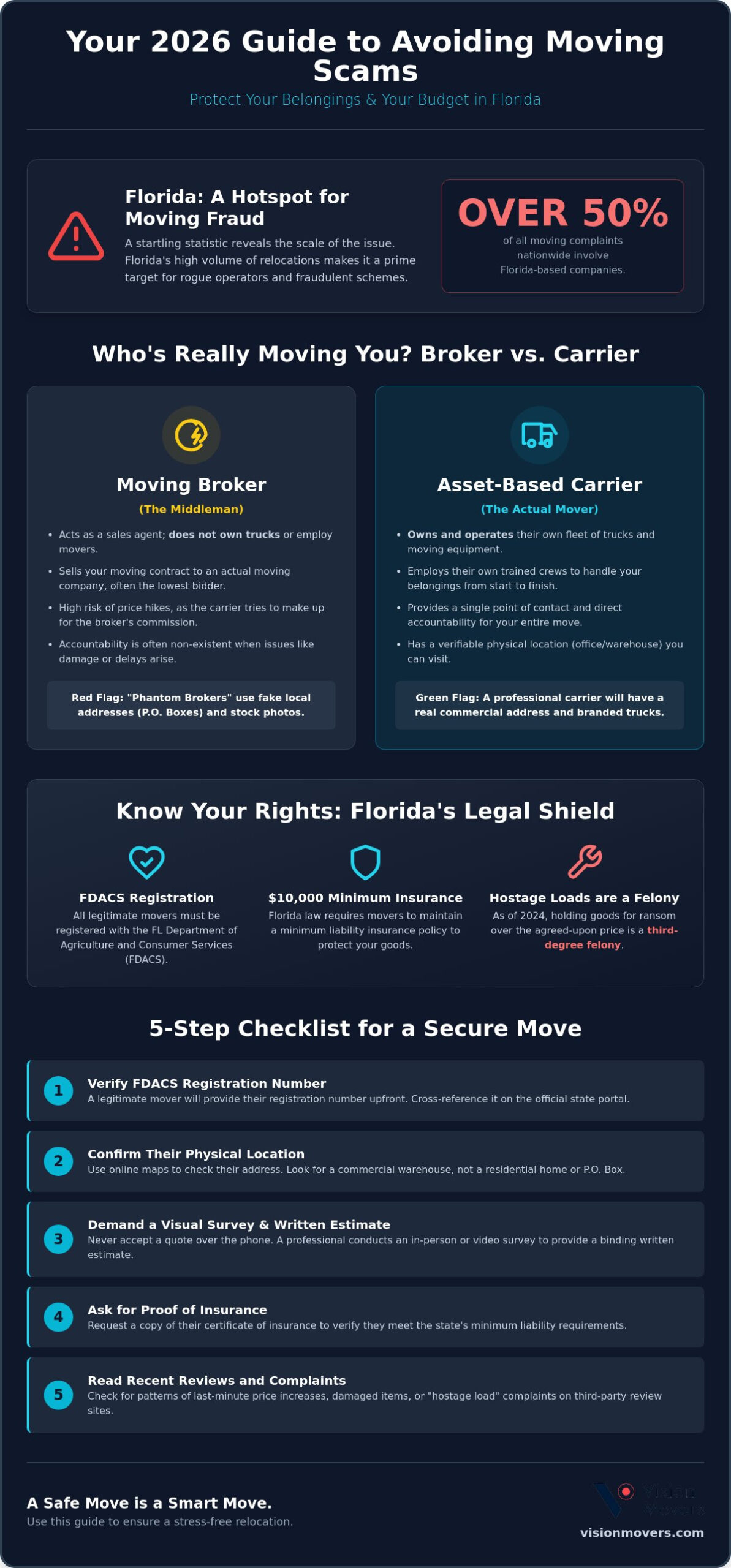
Did you know that over half of all moving-related complaints nationwide involve companies and brokers based right here in Florida? It is a startling figure that highlights why being cautious is not just smart; it is essential for your protection. We understand the stress of handing over everything you own to a team of strangers. You should not have to worry about your belongings being held for ransom or seeing a low estimate transform into an impossible bill on delivery day. Learning how to avoid moving scams in Florida is the most important step you can take to ensure your relocation remains a positive milestone rather than a legal headache.
This 2026 protection guide provides a clear path to a safe move by showing you how to use the latest consumer standards to your advantage. We will walk you through verifying mandatory FDACS registration numbers, explain how Senate Bill 304 strengthens your rights, and provide a practical checklist for vetting any company. You will learn to identify the red flags of rogue brokers and understand the $10,000 minimum liability insurance requirements that every legitimate mover must maintain. By the end of this article, you will have the tools and confidence to secure a professional team that respects both your property and your budget.
Key Insights for a Secure Relocation
- Learn how to avoid moving scams in Florida by verifying mandatory FDACS registration numbers and insurance credentials through official state portals.
- Understand the critical difference between a moving broker and an asset-based carrier so you know exactly who is handling your belongings.
- Protect your moving budget by spotting red flags early, such as a refusal to perform a visual survey or provide a binding written estimate.
- Gain peace of mind with an overview of the 2026 legal protections that make it a felony for rogue movers to hold your goods for ransom.
- Use our professional vetting checklist to confirm a company’s physical location and reputation for a transparent, stress-free transition.
The Rising Threat of Moving Scams in Florida
Florida remains a primary target for “moving cowboys” and rogue operators because of our state’s high volume of residential transitions. With thousands of people moving in and out of the Sunshine State every month, scammers see a constant stream of opportunities to exploit the stress of relocation. While the history of moving scams shows that these predatory tactics have existed for decades, the methods used in 2026 have become far more deceptive. Scammers now utilize digital impersonation, using AI-generated websites and spoofed caller IDs to look like established, asset-based companies.
The impact of these crimes goes beyond a simple financial loss. When a family falls victim to a “hostage load” scenario, their entire life is effectively locked in the back of a truck. The emotional strain of not knowing where your belongings are, or if you will ever see them again, is immense. Learning how to avoid moving scams in Florida starts with recognizing that these criminals rely on your desire for a quick, cheap solution. They count on you skipping the verification process in favor of a low price, but the true cost of a scam is always higher than a professional estimate.
Common Scams Impacting South Florida Residents
The “Low-Ball” estimate is often the first trap. A scammer provides an impossibly low quote over the phone without seeing your home, only to double or triple the price once your goods are loaded. In “Hostage” ruses, movers refuse to unload your furniture at the new destination unless you pay thousands in cash for “unforeseen fees.” Finally, the “No-Show” deposit scam involves a company taking a large upfront payment and simply disappearing on moving day, leaving you with a packed house and no way to transport it.
The Legal Framework: Florida Chapter 507
Florida Chapter 507 serves as the primary consumer protection statute governing the conduct and registration of intrastate moving companies. This law requires every mover to register with the Florida Department of Agriculture and Consumer Services (FDACS) and display their registration number clearly on all paperwork. The 2024 updates to these statutes have significantly increased the pressure on rogue operators for 2026. It is now a third-degree felony in Florida for a mover to refuse to release your belongings if you have paid the amount specified in your written estimate. These stricter penalties provide law enforcement with the teeth needed to intervene quickly when a move goes wrong.
By staying informed about these legal requirements, you can spot a legitimate professional from a mile away. A reputable mover will never shy away from providing their credentials or explaining your rights under Florida law. Protecting yourself is about more than just checking a box; it is about ensuring your transition to a new home is handled with the care and transparency you deserve.
Identifying the “Phantom Broker” vs. Asset-Based Movers
One of the most effective ways to understand how to avoid moving scams in Florida is to distinguish between a moving broker and a moving carrier. A carrier is an asset-based company. They own the trucks, employ the crews, and handle your belongings from start to finish. In contrast, a moving broker is essentially a sales office that acts as a middleman. They don’t own moving equipment or employ movers. Instead, they sell your moving contract to the highest bidder. This distinction is critical because brokers are often the primary source of “surprise” price hikes. Because the broker takes a significant commission off the top, the actual moving company that shows up often realizes the remaining balance won’t cover their costs, leading them to demand more money on moving day.
Identifying a “phantom broker” requires a keen eye for digital red flags. Many websites serve as lead-generation fronts. They use stock photos of trucks and professional crews to appear like a real local business, but they lack a physical address in Florida. A reputable carrier will have a verifiable physical presence in cities like Fort Lauderdale or Miami. You should be able to visit their office or see their branded trucks on the road. If a company’s website lists a P.O. Box or a residential address instead of a commercial warehouse, proceed with extreme caution. Verifying physical assets is a foundational step in securing a safe relocation.
The Risks of Hiring a Moving Broker
Hiring a broker often leads to a complete lack of accountability. If your furniture arrives damaged, the broker will likely tell you to contact the mover, while the mover may claim the broker misquoted the inventory. This “sell-off” model means your move is auctioned to whichever company is willing to do the job for the lowest price, often resulting in sub-contracted crews who haven’t been properly vetted. By law, brokers must disclose in their advertisements and contracts that they do not perform the move themselves, but this information is frequently buried in the fine print.
Benefits of Asset-Based Local Movers
When you work with an asset-based company, you enjoy direct communication with the team handling your life’s work. You aren’t dealing with a call center in another state; you are talking to the people who will be in your home. Choosing a local moving service provides tangible accountability because the company’s reputation is tied to its local community. You get uniformed employees who are trained to meet specific company standards, rather than day laborers hired at the last minute. This consistency ensures a level of security and care that a broker simply cannot guarantee. If you want to ensure your move is handled by a team you can trust, consider booking with a transparent local carrier that owns its fleet and values its neighbors.
5 Steps to Verify a Florida Moving Company in 2026
Taking control of your relocation begins with a systematic verification process. You don’t have to be a private investigator to uncover the truth about a company; you simply need to know where to look. By following these five steps, you can ensure that the team you hire is legitimate, insured, and accountable. This proactive approach is the most effective way to understand how to avoid moving scams in Florida and protect your family’s assets.
The FDACS Registration Check
The Florida Department of Agriculture and Consumer Services (FDACS) maintains a public database that is your first line of defense. Visit the FDACS website and use the “Business Lookup” tool to search for the company by name or registration number. An “Active” status indicates the company has met state requirements, including maintaining the necessary insurance and bonds. If you see a “Revoked” or “Expired” status, it means the company is operating illegally and lacks the oversight needed to protect you. All intrastate movers must have an IM registration number to operate legally within the state.
Federal Verification for Interstate Moves
If your journey takes you across state lines, you must verify the company through the Federal Motor Carrier Safety Administration (FMCSA). Use the “Protect Your Move” portal to check the company’s USDOT and MC numbers. This database allows you to review safety records, fleet size, and any history of formal consumer complaints. Verified interstate movers require higher insurance thresholds than local companies, providing an additional layer of financial security for your long-distance transition.
Physical Address and Documentation
Never hire a mover that only lists a P.O. box or a residential address. A legitimate professional operation requires a physical warehouse and office space to manage their fleet and equipment. Use satellite imagery to confirm the address is a commercial location with branded trucks. Additionally, pay close attention to the paperwork provided. Federal law requires movers to provide you with a copy of the “Your Rights and Responsibilities When You Move” booklet during the planning stage. If a company fails to provide this document or presents a blank “Bill of Lading” for your signature, stop the process immediately. A transparent Bill of Lading should clearly outline the services, costs, and delivery dates before you ever pick up a pen. This document is your final contract; it must be complete and accurate to ensure a smooth, dispute-free experience.
Red Flags to Watch for During the Estimate Process
The estimate phase is often where a scammer first attempts to bait the hook. If you want to know how to avoid moving scams in Florida, you must pay close attention to the behavior and communication of the estimator before any contracts are signed. One immediate warning sign is a generic phone greeting. If a representative answers with a vague phrase like “Moving Company” or “Movers” instead of a specific, branded name, they are likely operating under multiple aliases to hide a history of complaints. A professional team takes pride in its brand and will always identify themselves clearly.
Legitimate companies insist on a visual survey of your home to provide an accurate quote. An over-the-phone estimate is a massive risk for any homeowner. Without seeing the layout of your residence or the actual volume of your belongings, a mover cannot account for logistical challenges like long carries, tight stairwells, or the need for specialty packing. If a mover refuses to perform an on-site or detailed virtual walkthrough, they are setting the stage to claim “unforeseen circumstances” later. This tactic is used to justify significant price increases once your items are already loaded on the truck.
The Estimate Trap: Binding vs. Non-Binding
You should never accept a non-binding estimate for your relocation. A non-binding estimate allows the mover to adjust the final price based on the actual weight or volume of the shipment, which rogue operators exploit through a “Revision Clause.” This clause is frequently used to legally double or triple your costs on moving day. To ensure your budget remains intact, verify that all moving quotes are provided in writing and signed by an authorized representative. Insist on a “Binding” or “Binding Not-to-Exceed” estimate, which guarantees that you will not pay more than the quoted price as long as the inventory remains the same.
On-Site Red Flags
During the walkthrough, observe how the estimator evaluates your home. If they spend less than 10 minutes looking at your belongings or fail to check closets, garages, and attics, they aren’t being thorough. Reputable residential moving services always conduct a comprehensive walkthrough to create a detailed inventory list, often called a “cube sheet.” This document serves as the foundation for your quote and prevents disputes regarding the amount of furniture being moved. Additionally, be wary of any company demanding a large cash deposit or “upfront insurance” fees. While small deposits are common, some Florida counties have ordinances that suggest a 20% cap on deposits to protect consumers from “no-show” scams. If you want a partner who values transparency and accuracy from the very first handshake, book a professional on-site consultation with our experienced team today.
Why Vision Movers is the Trusted Choice in South Florida
Choosing a reliable partner is the final and most vital step in understanding how to avoid moving scams in Florida. At Vision Movers, we don’t just meet the minimum state requirements; we exceed them to provide our clients with a superior level of security. Our commitment to 100% transparency means you never have to worry about hidden fees or “hostage load” scenarios. We maintain a fully licensed and insured operation with a physical presence in Broward County, providing the tangible accountability that “phantom brokers” simply cannot offer. When you work with us, you are working with a local team that values its reputation within the South Florida community.
Our methodical approach is designed to eliminate the inherent stress of relocation. We treat your belongings with “White-Glove” care, utilizing professional-grade materials and techniques to secure everything from everyday household items to high-value specialty goods. By handling every aspect of the move ourselves, we maintain a chain of custody that ensures your possessions are never auctioned off to unvetted third parties. This direct oversight is the key to a predictable, successful transition that stays on schedule and within your budget.
Local Expertise in Miami, Fort Lauderdale, and Beyond
We have been serving neighbors in Weston, Boca Raton, and Coral Springs since 2016, giving us a deep understanding of South Florida’s unique logistics. Our crews are well-versed in the specific requirements of local high-rise buildings, gated communities, and commercial districts. We include professional packing and furniture protection as a standard part of our service to prevent damage before it happens. This local expertise allows us to navigate the complexities of Miami and Fort Lauderdale traffic and regulations with ease, ensuring your moving day remains calm and organized.
Secure Your Move with Confidence
We believe that peace of mind begins with an accurate, binding estimate. Our estimators conduct thorough walkthroughs to ensure every detail is accounted for, protecting you from the price hikes often associated with vague, over-the-phone quotes. This disciplined process has made us a leader in both residential and commercial moving across the region. We take pride in being a helpful guide for our clients, offering clear solutions to potential relocation challenges before they arise. If you are ready to experience a move defined by transparency and professional care, Get a transparent moving quote from Vision Movers today and let our capable experts handle the heavy lifting for you.
Secure Your Sunshine State Move Today
Your transition to a new home should be a time of excitement, not anxiety. By prioritizing state registration checks and insisting on in-person walkthroughs, you have already mastered the essentials of how to avoid moving scams in Florida. Remember that a legitimate mover will always provide a binding written estimate and display their credentials openly. These simple verification steps are your best defense against rogue operators and hidden fees. Protecting your belongings is possible when you know the right questions to ask and which red flags to avoid.
Beyond protecting your physical goods, veterans moving to the area should also ensure their home financing is in order; exploring VA home loans Melbourne FL can help guarantee a smooth financial transition into your new residence.
Since 2016, Vision Movers has completed thousands of successful South Florida moves with a focus on total transparency. We are fully registered with both the FDACS and FMCSA, providing you with the peace of mind that comes from working with a verified professional. Our team is ready to provide the white-glove care your belongings deserve, whether you are moving across town or across the country. Request a Free, Transparent Moving Estimate from Vision Movers and take the first step toward a stress-free relocation. You deserve a partner who values your property as much as you do.
Frequently Asked Questions
Is it normal for a Florida moving company to ask for a large deposit?
It is not normal for a reputable company to demand a large cash deposit before your moving day. While small booking fees are common to secure a date, asking for more than 20% of the total estimate is a significant red flag. Legitimate movers typically collect the majority of the payment upon delivery. Paying with a credit card provides an extra layer of fraud protection that cash or wire transfers simply cannot offer.
How can I check if a mover is registered with the state of Florida?
You can verify a mover’s status through the Florida Department of Agriculture and Consumer Services (FDACS) website. Use their “Business Lookup” tool to search for the company’s name or IM registration number. This step is essential when learning how to avoid moving scams in Florida. An active registration confirms the company has filed the necessary paperwork and maintains the insurance required by state law to protect your belongings.
What should I do if a mover holds my belongings hostage in Florida?
If a mover refuses to unload your goods after you have paid the amount on your written estimate, call local law enforcement immediately. In Florida, refusing to release household goods after receiving payment of the estimate is a third-degree felony. You should also file a formal complaint with the FDACS. Having your written, signed estimate ready to show responding officers is the fastest way to resolve the situation and secure your property.
Do Florida movers have to be licensed and insured?
Yes, all movers operating within the state must be registered with the FDACS and maintain specific insurance coverage. State law requires movers to carry at least $10,000 in liability insurance per shipment for loss or damage caused by their negligence. For moves crossing state lines, the company must also have a valid USDOT number and meet federal insurance thresholds to operate legally and provide you with adequate financial protection.
What is the difference between a binding and non-binding estimate?
A binding estimate is a guaranteed price for the services and inventory listed, while a non-binding estimate is an approximation of the final cost. With a non-binding quote, the final price is determined by the actual weight or volume of your goods. In Florida, the final price of a non-binding move cannot exceed 110% of the original estimate at the time of delivery. Always insist on a binding estimate to keep your budget predictable.
Can I sue a moving company for a scam in Florida?
You can pursue legal action against a moving company in Florida civil court for breach of contract or fraud. If your damages are under $8,000, you may be able to file in small claims court without an attorney. For larger losses, consulting with a lawyer who specializes in consumer protection is recommended. If you need to understand how criminal statutes and penalties vary by state, visit Mission Focus Legal Group for comprehensive legal resources. Documenting all communication and keeping copies of every signed contract will be vital for your legal case.
Are moving brokers legal in Florida?
Moving brokers are legal in Florida, but they must follow strict disclosure and registration rules. They are required to register with the FDACS and maintain a $50,000 performance bond or certificate of deposit. A broker must clearly state in all advertisements and contracts that they are not a moving company and do not perform the actual relocation. Understanding this distinction is a key part of how to avoid moving scams in Florida.
How do I report a moving scam to the Florida Attorney General?
You can report a moving scam to the Florida Attorney General by filing a formal complaint through the “My Florida Legal” website. You can also call their fraud hotline at 1-866-9-NO-SCAM to speak with a representative. Provide as much detail as possible, including the company’s name, registration numbers, and copies of all contracts. This information helps state authorities investigate rogue operators and prevents other families from becoming victims of similar schemes.








Esenyurt Korsan Taksi Her Zaman En İyisi