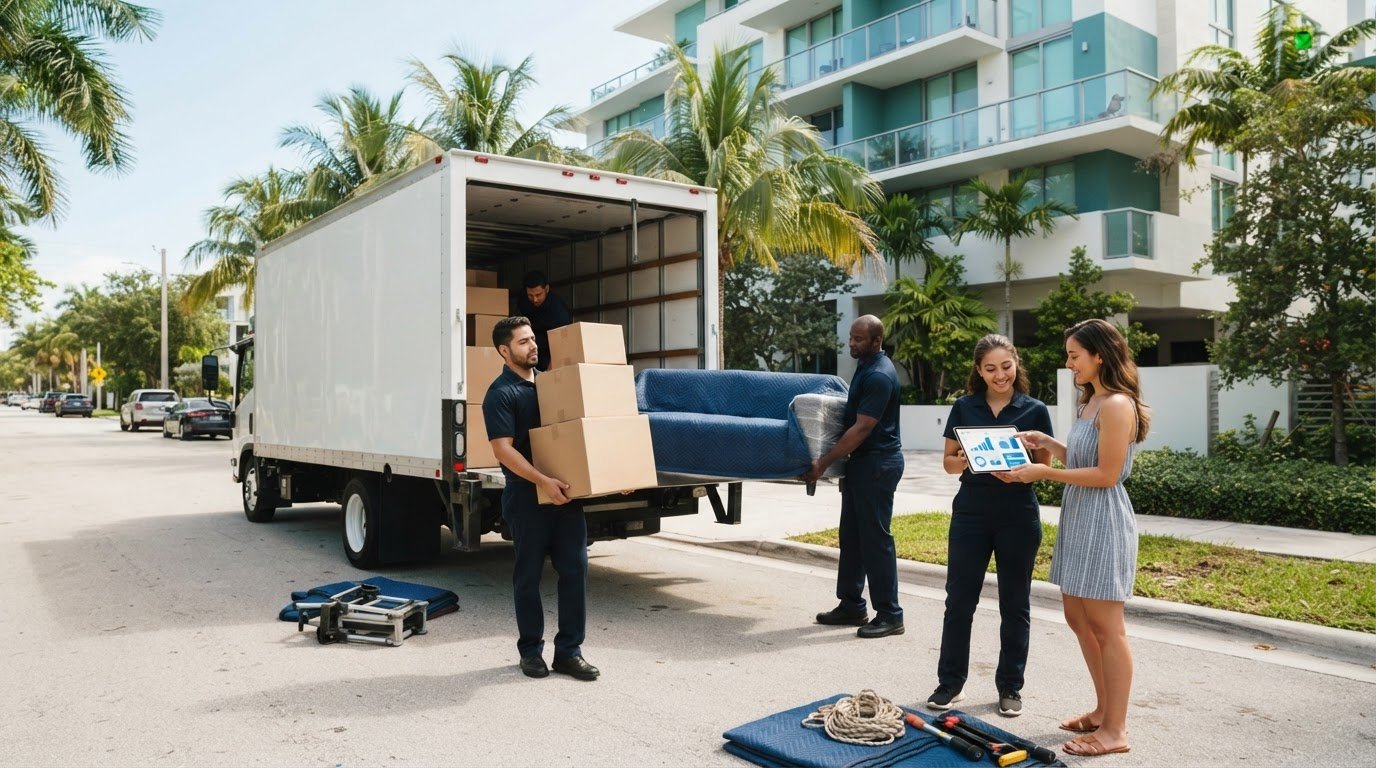
A move handled by short-distance movers in Miami is typically under 50 miles, stays within Florida, and generally takes one day. The price depends on the move and is provided after a quote request, with the load size, destination, packing, and storage shaping the estimate. Miami’s busiest moving season runs from May through September, so plan to book at least a few weeks ahead if you’re moving then.
Even a short-distance move in Miami can involve more than the distance between addresses. Building access, the size of your load, and the services you need all affect the moving plan and estimate. It’s reasonable to want clear pricing before you commit, with a straightforward explanation of what the work includes.
This guide explains what can shape a short-move estimate, how flat-rate pricing differs from other estimates, and which details can affect the final total. You’ll also learn when to schedule your move and what to expect from residential and commercial relocations in Miami, so you can plan the next steps with greater confidence.
Key Takeaways
- Separate a local move from a long-distance relocation by considering both mileage and whether the route crosses state lines.
- Build a more useful estimate by accounting for the size of the load, building access, packing needs, and any storage.
- Before accepting a flat-rate estimate, understand what work it covers and which circumstances could affect the final total.
- For residential and office moves, plan around the property’s access needs and the items that must be moved.
- Review the mover’s services, customer reviews, pricing details, and liability terms; basic liability is limited to $0.60 per pound per article.
Thinking About Moving in Miami?
When choosing movers for a nearby relocation, compare the written scope, licensing and insurance information, and customer feedback. These details help you understand what the crew will handle and how your belongings will be protected.
Start with the company’s legal business name and make sure it matches the estimate and moving paperwork. Review any credentials or industry recognition the company publicly identifies, then check that the information belongs to the same business. Recognition matters most when its issuing organization and criteria are clear, not simply because a logo appears on a page.
Ask how crews are trained to handle packing, lifting, furniture protection, and transport. Background-check practices should be explained as part of the company’s hiring process, rather than assumed from a uniform or truck. Customer reviews can add context: compare recent comments about punctuality, communication, and careful handling, and look for consistent patterns across several reviews.
Referrals are most useful when they include specific details. A friend who describes how a crew protected a dining table or managed a narrow stairwell gives you more to evaluate than a general recommendation. Compare those examples with customer feedback and the written estimate.
For a moving truck, parking arrangements depend on the pickup and delivery properties and the street. Ask building management about loading areas or dock reservations, and contact the relevant local parking office about curb access or any required authorization.
A local moving estimate should make clear which services are included, such as loading, transportation, and unloading, and whether packing or furniture disassembly is part of the plan. Request a written scope that reflects the preparation your move requires.
Estimates and Transparent Pricing
A useful estimate connects the listed work to your belongings and access conditions. Provide an accurate inventory, note stairs or elevators, and identify packing, storage, and bulky-item needs. Vision Movers provides a free personalized estimate, with transparent pricing and no hidden fees. Load size, destination, access, and requested services all help shape it. Compare the same tasks when reviewing estimates.
Miami-Dade Service Coverage
Miami-Dade moves can connect different neighborhoods, building types, and loading conditions. Share both addresses and explain whether either property has a loading dock, elevator, restricted access, or limited curb space. This helps define the transport plan and the work included, whether belongings are moving between apartments, houses, or office spaces within the county.
Read the estimate’s liability terms as carefully as its service list. Basic liability is limited to $0.60 per pound per article. That means the stated protection is based on an item’s weight, not necessarily its replacement value, so the written terms deserve attention before moving day.
How far in advance should I hire movers?
Book around your move’s complexity, not just the miles between addresses. Miami’s busiest moving season typically runs from May through September, when booking at least a few weeks ahead helps you plan around peak demand.
Miami moving companies that provide local moving services can handle nearby relocations, including apartment and house moves. Compare the service scope, customer reviews, written estimates, and licensing details rather than choosing by distance alone. A local move is typically less than 50 miles and stays within Florida, but building access and the amount of furniture still affect scheduling.
For a residential move, set the date first, then prepare an accurate inventory and flag bulky or fragile belongings. Smaller moves still need a loading plan: a few packed boxes and one sofa require different handling from a furnished home. If you’re moving during May through September, reserve the date at least a few weeks ahead. For other periods, arrange the booking as soon as your moving date and access details are clear.
Office moves need coordination beyond packing desks. Identify equipment that must remain accessible, plan how staff will label boxes, and establish when the new workspace can receive the moving truck. A last-minute move leaves less time to coordinate building access, elevators, and loading areas. Share those constraints early so they can be included in the moving plan.
Specialty furniture and pianos need early planning because their size, weight, and route through the property affect handling. Describe each item, where it is located, and any narrow hallway, stairwell, or elevator between it and the truck. For example, a piano on an upper floor needs a different loading plan from a packed bookcase beside the front door. Clear access details help the crew prepare to load and unload carefully.
Distance also shapes the schedule. An intrastate move begins and ends in the same state and is typically more than 50 miles. An interstate move crosses a state line, even if the destination is nearby. Tell the moving company both addresses and the route’s state boundaries so it can plan the transport and required paperwork appropriately.
High-rise moves call for advance coordination with building management. A Miami move involving the 23rd or 24th floor may require an elevator reservation, loading-area arrangements, and a defined move-in window. Confirm those details before booking the crew, then share the approved access plan and truck parking location.
Before moving day, finish packing, label boxes by room, separate essential items, and clear paths to doors and elevators. Keep building access instructions with your inventory. These steps give short-distance movers in Miami a clear loading sequence and help you stay organized as belongings arrive and are unloaded.
How much do movers cost in Miami?
A Miami moving estimate depends on the load, route, access, and services requested. Start by identifying whether the move is local or long-distance, then compare what each estimate includes.
Local Residential Moves in Miami
A local move is typically less than 50 miles and does not cross state lines; it generally takes one day. In a Miami home move, the inventory matters as much as the route: a lightly furnished apartment differs from a house with bulky furniture, packed boxes, and items needing careful handling.
Vision Movers provides a free personalized estimate with transparent pricing and no hidden fees. Load size, destination, packing, access, and storage needs shape the estimate, so describe each clearly when requesting one.
Local and Long-Distance Move Definitions
Distance terms can differ between moving companies. A local move stays within Florida and is typically under 50 miles, while a long-distance move is generally considered 400 miles or more. Some companies define long-distance as more than 50-100 miles, so check which definition applies to the route in your estimate.
State lines matter, too. A move from Miami to another Florida city is an intrastate move; a move from Miami across state lines is interstate. The route, shipment size, and services requested affect how the job is planned.
Moving Locally Across Miami
A move between Miami neighborhoods can involve different access conditions, even when the addresses are close. An apartment with elevator access, for example, differs from a house with a long carry between the entrance and the truck. Share both addresses and describe parking, stairs, elevators, and loading restrictions.
Those details help define the estimate’s scope. Include furniture, boxes, packing needs, and any planned storage, rather than describing the move only as a short trip across Miami.
What Shapes the Estimate?
Compare estimates by matching the inventory and requested work. One plan might include packing; another might cover loading, transportation, and unloading only. Ask what each written estimate covers, and note whether furniture disassembly or storage is included.
Route distance is only one factor. Load size, property access, and handling requirements all affect the moving plan and estimate.
Review insurance information separately from the price. Vision Movers is fully licensed and fully insured for local and long-distance moves. All belongings are insured, and additional insurance is available if needed. Read the written estimate to understand the services and conditions it covers.
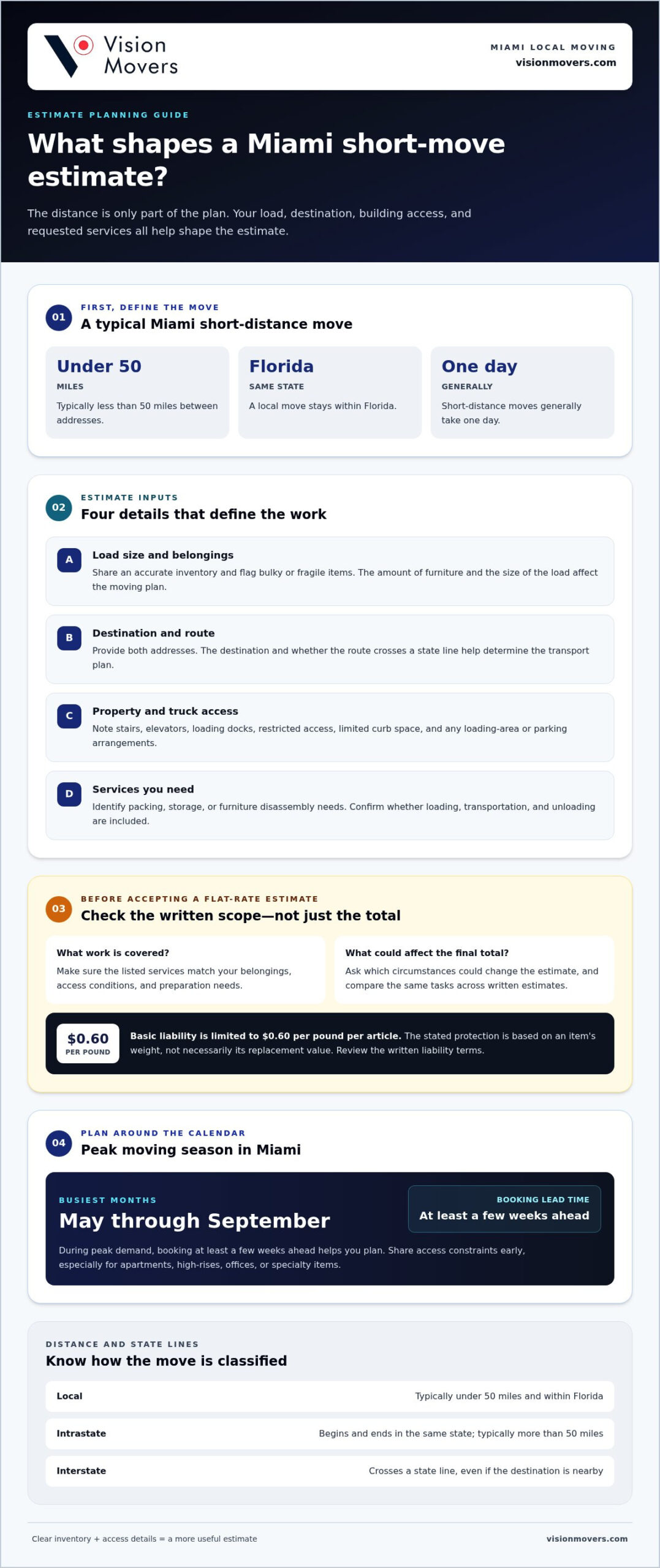
Residential and commercial relocations
A home move and an office relocation need different plans, even when both stay in Miami. Begin with an inventory, identify access restrictions, and decide which belongings must be ready first on moving day.
Residential Moves
For a Miami apartment or house, group boxes by destination room and label them clearly. Separate fragile belongings, bulky furniture, and essentials you’ll need immediately after arrival. For example, mark bedding and kitchen basics for quick unloading instead of mixing them with boxes intended for storage.
Walk the route from each room to the building exit before moving day. Note tight turns, stairs, elevator access, and items that need disassembly. Share those details with the moving company so the crew can plan the loading sequence and protect floors and doorways.
Commercial and Office Relocation
An office move works best when one person coordinates decisions between the current and new locations. Create a department inventory, label each workstation by its destination, and identify equipment that should remain accessible until the final workday. A clear system helps staff find essential items after unloading.
Before the crew arrives, assign responsibility for computers, confidential files, and shared equipment. Keep cables with their devices, and label monitor and workstation boxes consistently. Discuss packing, furniture handling, and transportation in the written scope so the crew understands what the business needs.
Confirm building access and loading instructions at both addresses. An office tower, for example, may require a reserved service elevator, while a street-level workspace may need a clear approach for the truck. Share those details with the moving team early and provide a contact person for questions during the move.
Intercity Relocation
A move from Miami to Fort Lauderdale stays within Florida, while a move across state lines is interstate. Share the exact origin and destination, your inventory, and the services you need. Route and shipment details help shape the transport plan, whether you’re moving to another South Florida address or farther away.
For a long-distance move, organize belongings by priority and destination room. Keep documents and daily essentials separate from packed items. Confirm how delivery timing, storage needs, and unloading instructions fit the written plan before the truck departs.
Ask how the moving team will protect furniture and handle loading and unloading. Specific answers about a dining table, office desks, or fragile equipment tell you more than a general claim of experience. A well-organized move depends on clear responsibilities, accurate labels, and shared access instructions.
On moving day, keep the inventory and contact details together. Walk through each space before departure and again after unloading. This helps you account for your belongings, identify anything that needs attention, and settle into your new home or workplace with a clear record.
Flat-rate estimates and hidden fees
A flat-rate estimate sets a total for the work described, rather than charging solely by the hour. Its value depends on how clearly the inventory, access, loading, transportation, and delivery details are set out in writing.
Before comparing estimates, give each moving company the same information. Include pickup and delivery addresses, large furniture, box count, stairs or elevators, and packing needs. An estimate based on an apartment with elevator access, for example, may not reflect a later change to stairs or a longer carry.
Vision Movers provides a free personalized estimate with transparent pricing and no hidden fees. Load size, destination, access, packing, and storage needs all shape it. Read the estimate line by line and check that each requested task appears in the scope. Clear descriptions make it easier to compare plans and understand what the total covers.
Ask how changes to the move affect the estimate. Adding a pickup stop, requesting packing after the estimate, or changing the delivery address can alter the work. A flat rate describes the agreed scope, so review any revised estimate against the original and identify what changed before approving it.
- Inventory: Check that bulky furniture and special handling needs are listed.
- Labor: Confirm whether packing, loading, unloading, and furniture disassembly are included.
- Access: Note stairs, elevators, long carries, and building loading rules.
- Route: Verify both addresses and any planned stops.
- Additional work: Identify how requested changes affect the written estimate.
Some adjustments reflect work outside the original scope, rather than a fee hidden in the estimate. Adding packing or storage, for instance, changes the requested services. Ask for any adjustment to be explained in writing, with the added task and its effect on the estimate stated clearly.
Check whether the estimate describes protection and handling for fragile belongings. Basic liability is limited to $0.60 per pound per article. That figure is based on an item’s weight, so review the written terms alongside the price and service details.
For a more efficient estimate, prepare an accurate inventory and describe access at both locations. Request a local moving estimate with those details ready, then compare the written scope with the services you need.
Vision Movers: Local Moving
Vision Movers provides Local Moving and Residential Moving for Miami-area households planning a nearby relocation. The team also provides professional packing, furniture protection, loading, and unloading to help keep belongings organized from pickup through delivery.
For a move between apartments, houses, or other local residences, share the addresses, inventory, access details, and packing needs when requesting a free estimate. Vision Movers also provides Commercial Moving and Interstate Moving for office relocations and moves across state lines. A clear outline helps shape a plan around the work involved.
Contact Vision Movers to discuss your local move and the support you need.
Make Your Next Move Feel More Manageable
A relocation can be a chance to create a smoother start in your new home or workplace. Before moving day, decide which rooms or work areas should be ready first, and keep first-day essentials easy to access. A clear priority list gives everyone involved a practical focus.
Choosing short-distance movers in Miami is one part of the plan. Vision Movers provides Local Moving and Residential Moving for household relocations, as well as Interstate Moving for moves across state lines. Match the services you need to the transition ahead, then share your priorities so the moving plan reflects what matters most to you.
When you’re ready to take the next step, contact Vision Movers today to discuss your move. A thoughtful plan can help you leave the old address with clarity and settle into what comes next with confidence.
Frequently Asked Questions
What is considered a local move in Miami?
A local Miami move is typically less than 50 miles and doesn’t cross state lines. For example, a relocation between two Florida addresses may qualify as local if the route stays below that distance. The city label alone doesn’t settle the classification: consider the full route and destination state. A move crossing into another state is interstate, even if the new address seems nearby.
What do short-distance movers in Miami typically charge per hour?
Vision Movers provides a free personalized estimate with transparent pricing and no hidden fees. Load size, destination, building access, packing, and storage needs shape the estimate. An apartment with elevator access and a small inventory, for example, may need a different plan from a home with bulky furniture and stairs. Compare the written scope to understand which services are included.
What is the average cost of a local move in Miami by home size?
Home size affects an estimate through the amount of furniture, boxes, and handling involved, so there isn’t one cost that applies to every home of the same size. A lightly furnished apartment and a fully furnished house can require different loading plans. Share an accurate inventory, access details, and packing needs when requesting your free personalized estimate.
How do Miami movers calculate minimum hours, travel time, and extra fees?
Use the written estimate to see how labor time, travel, and added tasks are treated. Look for any minimum charge, when billable time begins, and whether packing, stairs, long carries, or extra stops affect the total. For example, adding a pickup location after the estimate changes the route and scope. Compare these terms alongside the listed services so the billing method is clear before moving day.
How can I compare licensed and insured local movers in Miami?
Review the business name on the estimate and read its licensing and insurance information. Vision Movers is fully licensed and fully insured for local and long-distance moves. All belongings are insured, and additional insurance is available if needed. Read the written terms to understand how protection applies to specific belongings, such as a glass table.
How far in advance should I book Miami movers, and what days are cheapest?
For a Miami move during the busy season, May through September, plan to book at least a few weeks ahead. No single weekday is cheapest for every move; the estimate depends on the route, inventory, access, and requested services. If your date is flexible, compare estimates for the dates you can use, with the same inventory and service requirements. That gives you a more meaningful comparison than choosing a day by assumption.
What common risks, hidden fees, or scams should I watch for when hiring Miami movers?
Watch for unclear written scopes, unexplained changes, and estimates that omit tasks you requested. Ask for each added charge and its reason to be documented before work changes. Miami movers must assume basic liability and clearly disclose that responsibility is limited to $0.60 per pound per article. Because weight-based liability may not reflect an item’s replacement value, read the terms carefully and understand what protection applies to your belongings.
Leave a Reply